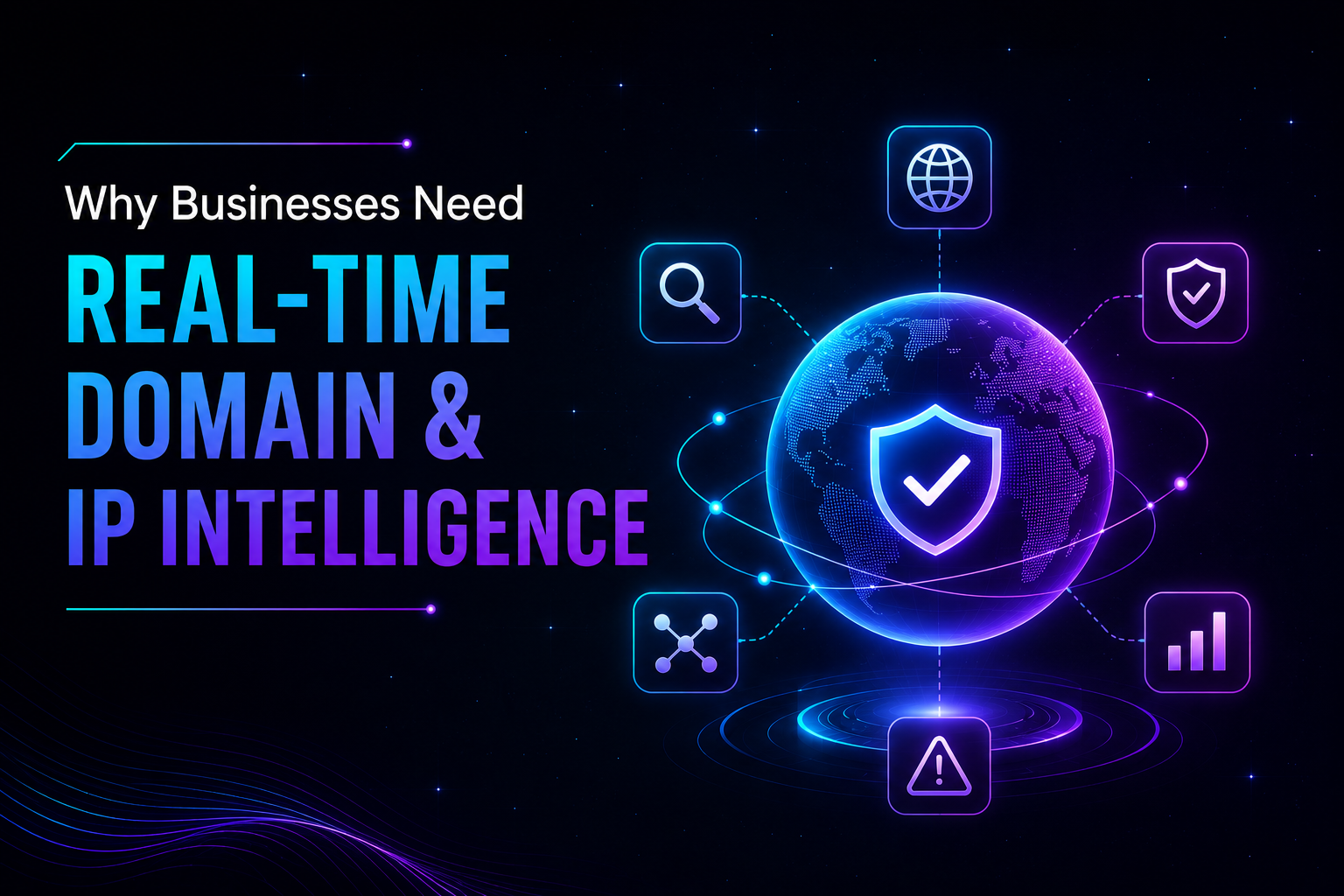
Domain & IP Intelligence isn’t a term most business owners wake up thinking about. And that’s exactly the problem. You’ve felt it, haven’t you? That low‑hum unease when you click an email link from a “partner” you don’t quite remember. Or when a new user signs up with an email that looks almost legitimate. Nothing has gone wrong yet. But something feels… off.
That’s the thing about doing business in India today. We’re not afraid of the obvious scam anymore. We’re tired. What keeps us up is the invisible stuff. The domain that was registered yesterday. The IP address that pinged from three cities in one hour. The partner who seems real but leaves no digital footprint.
This isn’t paranoia. It’s pattern recognition. And it’s exactly why real‑time Domain & IP Intelligence is no longer a “nice to have.” It’s becoming the quiet foundation of how smart businesses operate.
1. The Trust Crisis We Don’t Talk About
We like to think India’s digital story is one of convenience-UPI, quick commerce, video calls with village families. And it is. But underneath, there’s a slower, heavier shift: trust is becoming transactional.
Think about your own work life. How many times last month did you double‑check a vendor’s domain? How many “client” emails landed in spam but looked real? We don’t say it aloud, but we’ve all started assuming guilty until proven otherwise online.
That’s exhausting. And it’s expensive.
Real‑time Domain & IP Intelligence steps into that gap. Not as a weapon. As a flashlight. It tells you, in seconds: Is this domain actually connected to the company it claims? Does this IP address have a history of suspicious behaviour? No guesswork. No gut feelings. Just data that lets you exhale.
2. Why “Checking Later” Is a Luxury You Can’t Afford
Here’s a scene that happens every day in a Mumbai or Bengaluru office:
A finance manager gets an invoice from a regular supplier. The email looks perfect-logo, signature, even the same payment terms. Only the bank account number changed. They pay it. Two weeks later, the real supplier calls asking where their money is.
The fraud happened in real time. The checking happened… never.
Most businesses still rely on “we’ll verify tomorrow” or “let’s run a manual check next week.” But threats don’t wait. A malicious domain can be active for just 48 hours-long enough to spoof your brand, scam your customers, or drain your account. By the time your team investigates, the IP address has moved countries.
Real‑time Domain & IP Intelligence flips that. It works at the speed of the internet. Every sign‑up, every transaction, every new partner request gets instant context. Not fear‑mongering-just facts. And facts give you permission to say “yes” faster, or “no” earlier.
3. The Silent Drain on Your Team’s Energy
Let’s be honest: your security or operations team is tired. They’re not tired because they’re lazy. They’re tired because they’re doing manual detective work that machines could do better.
Someone has to manually check WHOIS records. Someone has to trace IP reputations across three different free tools. Someone has to maintain an Excel sheet of “suspicious domains” that grows faster than it gets used.
That’s not strategy. That’s survival mode.
When you integrate Domain & IP Intelligence into your workflows-your CRM, your payment gateway, your onboarding forms-you stop asking humans to act like robots. You let the intelligence handle the 95% of obvious cases. Then your team can focus on the 5% that actually needs judgment.
That shift alone changes morale. It changes retention. It changes how your people feel about their work on a Tuesday afternoon.
4. The India‑Specific Reality: Spoofing Is Personal Now
We’ve all gotten the “Your KYC needs updating” SMS from a number that looks exactly like our bank’s. Or the WhatsApp message from “Amazon” asking for OTP. These aren’t random anymore. They’re targeted, localised, and disturbingly convincing.
What’s worse? They often use domains that are one character off from the real company. amaz0n.in instead of amazon.in. flipkart-support.net instead of flipkart.com.
For a consumer, that’s annoying. For a business, it’s catastrophic when a scammer spoofs your domain. Your customers lose money. They blame you. Trust evaporates overnight.
Real‑time Domain & IP Intelligence helps you monitor for typosquatting, lookalike domains, and malicious IP ranges that target Indian users. You catch the spoof before your customers do. That’s not just security-that’s decency.
3. From “Why Bother?” to “How Did We Manage Without It?”
There’s a phase every business goes through. It’s the phase where you think: We’re small. No one would target us. Or: We’ve never had a breach, so why change?
That’s the same logic as “I’ve never had a fire, so I don’t need a smoke alarm.”
The truth is, most attacks aren’t personal. They’re automated. Bots scan millions of domains and IP addresses every hour, looking for one weak spot. Your size doesn’t matter. Your vulnerability does.
Once you start using Domain & IP Intelligence, you realise how blind you were before. You see patterns. You see repeat offenders. You see that the same IP range that tried to break into your test server also hit three other startups in your coworking space.
That awareness changes how you build products, onboard clients, and even hire remote teams. It becomes second nature. Like locking your front door.
Conclusion
Nobody wakes up excited to check domain reputations. That’s not the dream. The dream is running a business that feels safe enough to focus on what actually matters: your product, your people, your purpose.
Domain & IP Intelligence doesn’t promise to eliminate all risk. Nothing can. What it offers is something more human: clarity when you need it most. The ability to look at a new partner, a strange login, or a suspicious email and know-not guess, know-whether to lean in or step back.
That’s the shift we’re living through. Not from trust to paranoia. But from blind trust to informed trust. And that’s a future worth building.
If this made sense to you, you’ll like this too: Domain Availability API: Complete Guide for Businesses