There’s a moment most product teams don’t talk about openly.
It’s when everything looks fine on the surface – signups are growing, traffic is increasing – but something feels off. Conversions dip. Support tickets rise. Fraud silently creeps in.
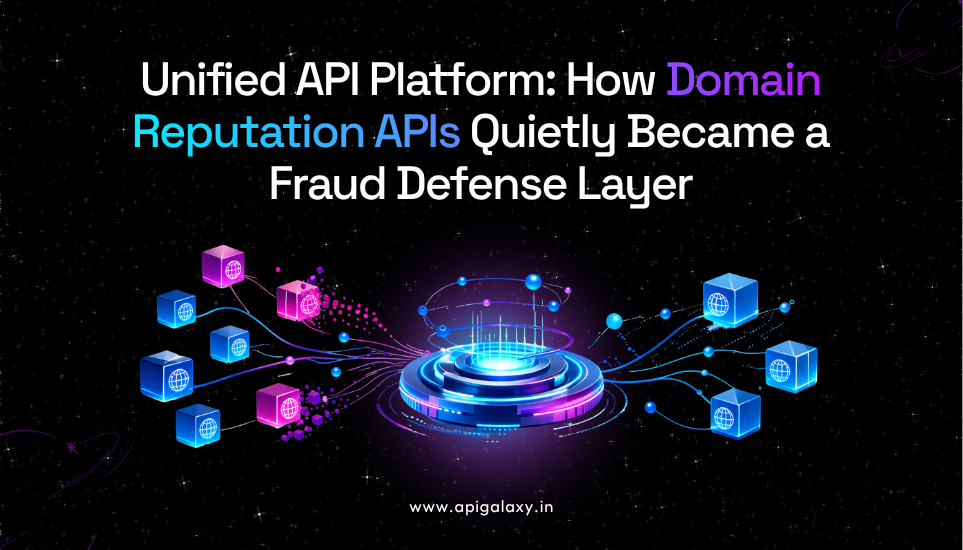
This is where a unified API platform – combined with domain reputation intelligence – starts becoming less of a “nice-to-have” and more of a necessity – especially when combined with something often overlooked: domain reputation intelligence.
Because today, fraud isn’t loud anymore. It’s subtle. Distributed. And often hiding behind something as simple as a domain name.
The Invisible Entry Point: Domains Are the New Attack Surface
Fraud doesn’t always start with stolen credentials.
Sometimes, it starts with a domain.
Temporary email domains, spoofed business websites, throwaway URLs – these are now the front line of abuse. Whether it’s fake user signups, phishing attempts, or payment fraud, domains are often the first signal something is wrong.
The problem? Most systems aren’t built to evaluate that signal in real time.
This is where Domain Reputation APIs come in – quietly scoring and flagging risky domains before they become a problem.
But here’s the catch: integrating them is rarely straightforward.
API Fragmentation Is Slowing Down Fraud Response
In theory, adding a domain reputation check sounds simple.
In reality, it’s another API.
And another.
And another.
Most growing startups today are already juggling:
- KYC verification APIs
- Payment gateways
- Fraud detection tools
- Communication APIs
Adding domain intelligence into this fragmented setup often means:
- More vendors
- More latency
- More points of failure
This is where the shift toward a unified API platform becomes obvious – not as a trend, but as a survival strategy.
Why Domain Reputation Alone Isn’t Enough
A domain reputation score by itself doesn’t solve fraud.
It becomes powerful only when it’s part of a larger decision system:
- Domain check + KYC mismatch
- Domain risk + abnormal payment behavior
- Disposable email + high transaction attempts
When these signals are scattered across different systems, teams struggle to connect the dots in time.
But when they’re unified – through a single API layer – the response becomes faster, sharper, and more reliable.
The Real Cost: Time, Not Just Money
Most teams underestimate the cost of managing multiple APIs.
It’s not just vendor pricing – it’s:
- Engineering bandwidth
- Integration delays
- Debugging across systems
- Compliance overhead
A report by RBI on digital payments and fraud trends highlights how delays in fraud detection directly impact financial loss and user trust.
Globally, firms like McKinsey emphasize that fragmented tech stacks slow down decision-making at scale.
In simple terms:
Fraud doesn’t wait for your integrations to stabilize.
How a Unified API Platform Changes the Equation
This is where the conversation shifts.
Instead of adding yet another standalone API, businesses are moving toward a unified API platform – where multiple services are already connected, standardized, and optimized.
Think of it as:
- One integration instead of five
- One system handling multiple signals
- One layer for scalability and security
In this setup, Domain Reputation APIs don’t sit in isolation – they become part of a broader fraud intelligence framework.
Platforms like API Galaxy are built around this exact idea:
- Combining KYC, payments, recharge, and verification APIs
- Providing consistent performance across services
- Reducing integration friction for product teams
Not as a sales pitch – but as a reflection of how infrastructure is evolving.
Developer Reality: Integration Fatigue Is Real
Talk to any backend developer or product manager – the problem isn’t lack of tools.
It’s too many tools.
Each API comes with:
- Different documentation
- Different response formats
- Different uptime reliability
Over time, this creates:
- Slower releases
- More bugs
- Higher maintenance costs
A unified API platform reduces this cognitive load.
Instead of managing complexity, teams focus on building product experiences – which is where actual growth happens.
Scaling Across Industries: Same Problem, Different Context
Whether it’s:
- Fintech onboarding flows
- Telecom recharge systems
- Travel booking platforms
The challenge remains the same:
High volume + real-time decisions + fraud risk
Domain reputation checks become critical in:
- Blocking fake accounts
- Preventing bot-driven abuse
- Reducing chargebacks
But scaling these checks across industries requires:
- Low latency
- High reliability
- Seamless integration
And again, this is where unified systems outperform fragmented ones.
Why This Shift Is Happening Now
This isn’t just about better technology.
It’s about pressure.
- Faster go-to-market expectations
- Increasing fraud sophistication
- Rising compliance requirements
- Global expansion challenges
Businesses don’t have the luxury of stitching together 10 different APIs anymore.
They need systems that:
- Work together
- Scale together
- Fail less
Which naturally leads to the adoption of a unified API platform approach.
Where Domain Reputation Fits In the Bigger Picture
Domain Reputation APIs are not the hero.
They’re the signal.
The real value comes from how quickly and intelligently that signal is used.
In a fragmented system → it’s delayed, isolated, often ignored.
In a unified system → it becomes part of a real-time decision engine.
And that difference is what separates:
- Reactive fraud prevention
from - Proactive fraud control
Final Thought
If you’re building or scaling a product today, the question isn’t:
“Should we add fraud detection?”
It’s:
“How quickly can we act on the signals we already have?”
Because fraud isn’t getting louder.
It’s getting smarter.
And the teams that win won’t just have better tools –
they’ll have better-connected systems.
Want to explore how modern API systems are evolving?
Read more here.