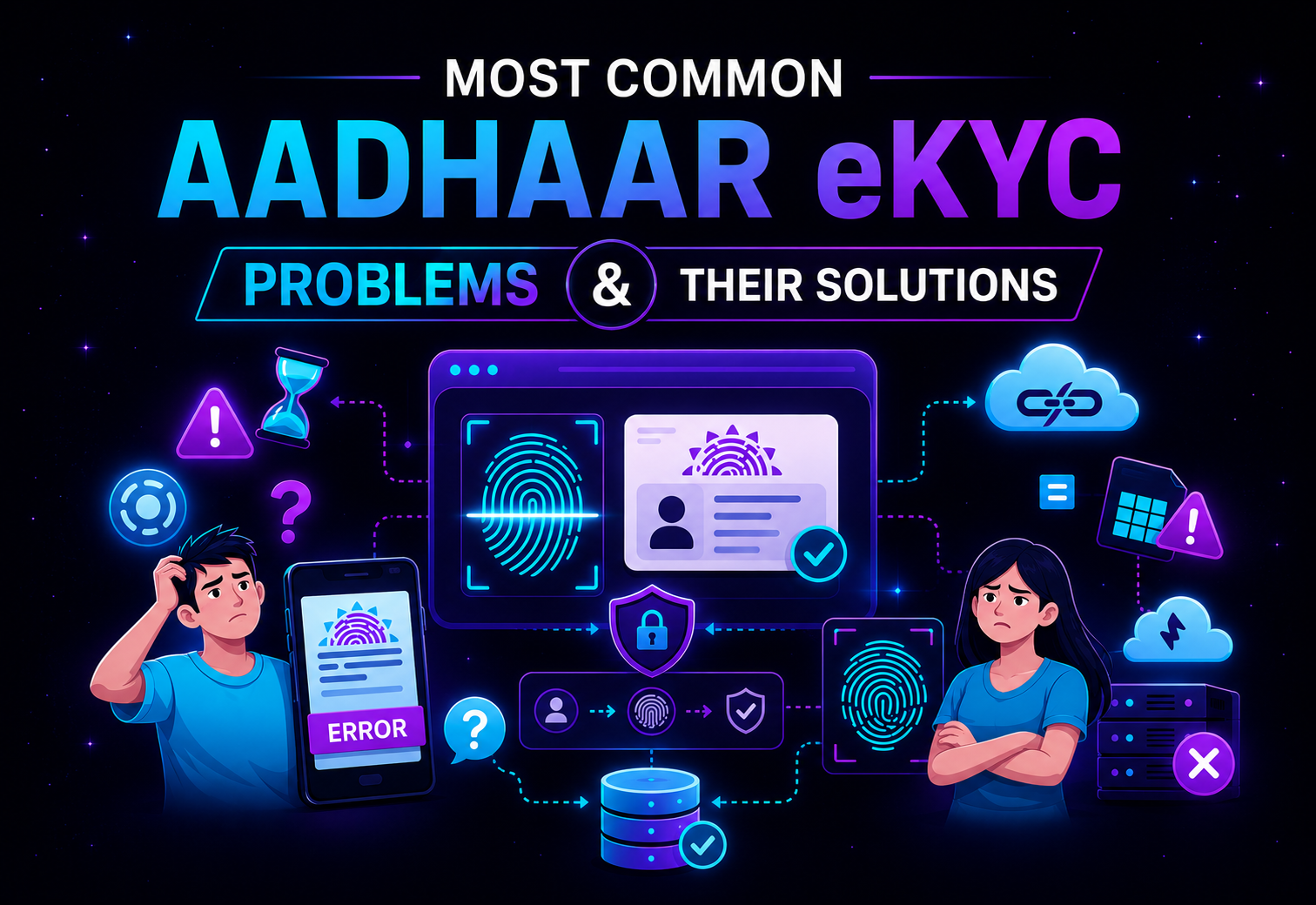
Aadhaar eKYC Problems are becoming more visible as India moves deeper into digital onboarding. What earlier felt like a simple OTP or biometric step now decides whether someone can open an account, verify identity, access a service, complete a fintech journey, or continue using a digital platform without friction.
For customers, these issues feel frustrating. For businesses, they create drop-offs, support tickets, failed onboarding, and loss of trust. And for startups, fintech brands, telecom platforms, travel businesses, and digital-first companies, even a small verification error can quietly become a growth problem.
That is why understanding these verification issues is not just a technical task anymore. It is part of building a smoother, safer, and more reliable digital experience.
Why Aadhaar eKYC Matters So Much Today
India’s digital ecosystem has changed quickly. People now expect instant access, instant verification, and instant approval. Whether it is a wallet, lending app, SIM service, travel booking platform, or financial product, users do not want long forms or repeated document uploads.
Link: https://www.npci.org.in/product/upi/product-statistics
This is where Aadhaar-based electronic Know Your Customer verification becomes important. It helps businesses verify identity faster and reduce manual checks. But when Aadhaar eKYC Problems appear during onboarding, the user rarely understands the backend reason. They only feel one thing: the platform is not working.
For companies like API Galaxy, which work around secure KYC Verification API, payment infrastructure, Recharge API, Bill Payment API, Travel API, and scalable API systems, these issues are a reminder that digital trust depends heavily on backend reliability.
1. Mobile Number Not Linked With Aadhaar
One of the most common Aadhaar eKYC Problems is when the user’s mobile number is not linked with Aadhaar. Since OTP-based eKYC depends on the registered mobile number, verification cannot move forward if the number is missing, inactive, or outdated.
Solution
The user should update or link their mobile number through an Aadhaar Seva Kendra or authorised Aadhaar update center. Businesses should also show a clear error message instead of a generic “verification failed” screen.
A simple message like “Your mobile number may not be linked with Aadhaar” can reduce confusion and support dependency.
2. OTP Not Received Or Expired
Another frequent reason behind Aadhaar eKYC Issues is OTP failure. Sometimes the OTP does not arrive because of poor network connectivity, telecom delays, server load, or an inactive SIM. In other cases, the OTP expires before the user enters it.
Solution
Platforms should allow users to resend OTP after a short waiting period, display the OTP validity clearly, and avoid forcing users to restart the entire onboarding journey.
API Galaxy’s developer-friendly verification infrastructure can help businesses design smoother flows where verification issues are handled with better error visibility and retry logic.
3. Name Mismatch Between Aadhaar And Business Records
Name mismatch is one of the most frustrating Aadhaar eKYC Errors. A customer may write “Rahul Sharma” in one place, while Aadhaar may show “Rahul Kumar Sharma.” Even small spelling differences, initials, spacing, or surname order can create failed verification.
Solution
Businesses should avoid overly strict matching wherever compliance allows. Instead, they can use intelligent matching logic that understands minor variations. Users should also be guided to enter their name exactly as printed on Aadhaar.
This is especially important for fintech, lending, insurance, telecom, and travel platforms where Aadhaar eKYC Problems can stop a legitimate customer from completing onboarding.
4. Biometric Authentication Failure
In biometric-based verification, fingerprints or iris scans may fail due to worn fingerprints, age, manual labour, device quality, dry skin, or poor scanner calibration. This is common in rural areas, field onboarding, banking correspondents, and assisted digital services.
Solution
Businesses should provide alternate verification options wherever possible, such as OTP-based verification or manual fallback checks. Devices used for biometric authentication must also be properly maintained and certified.
When Aadhaar eKYC Problems happen during biometric verification, the user should not be blamed. Often, the issue is with the device, environment, or process design.
5. Aadhaar Details Are Outdated
Many users still have old addresses, old mobile numbers, spelling errors, or outdated demographic details in Aadhaar. When these details do not match the information entered on a digital platform, Aadhaar eKYC Failed messages may appear.
Solution
Users should update their Aadhaar details through official channels. Businesses should guide them clearly instead of showing a vague failure message.
A better user experience would say: “Your Aadhaar details may need to be updated before verification can be completed.”
This small clarity can reduce panic and make verification issues easier to resolve.
6. Server Downtime Or API Connectivity Issues
Sometimes the customer has done everything correctly, but the verification still fails because of backend issues. API downtime, timeout errors, poor routing, weak integration, or high transaction load can lead to failed checks.
This is where businesses often underestimate infrastructure. The app may look polished, but if the verification API is unstable, the entire onboarding experience suffers.
Solution
Businesses should work with reliable API partners that offer scalable infrastructure, proper uptime monitoring, secure transaction handling, and real-time dashboards.
API Galaxy helps businesses manage digital transaction flows with secure APIs, scalable architecture, fraud detection systems, and reliable backend support, reducing the chances of Aadhaar eKYC Problems turning into customer drop-offs.
7. User Consent Or Authentication Flow Issues
Aadhaar eKYC depends on user consent. If the user skips a step, closes the screen, denies permission, or does not understand the consent message, verification can fail.
This is not always a technical error. Sometimes the interface is simply confusing.
Solution
Make the consent flow simple, transparent, and human. Explain why verification is needed, what data is being checked, and how the information will be used.
Good onboarding is not just about APIs. It is also about trust. When users understand the process, Aadhaar eKYC Problems reduce naturally.
How Businesses Can Reduce Aadhaar eKYC Problems
The biggest mistake businesses make is treating verification failure as a user-side issue. In reality, many failures come from poor UX, weak API integration, unclear error messages, and lack of fallback options.
To reduce Aadhaar eKYC Problems, businesses should:
- Use clear and specific error messages
- Provide retry options
- Keep OTP flows simple
- Avoid unnecessary form complexity
- Use reliable KYC Verification API infrastructure
- Monitor failed verification patterns
- Add fallback verification journeys
- Educate users in simple language
API Galaxy supports businesses with secure verification APIs, real-time dashboards, scalable API infrastructure, and developer-friendly integration that helps digital platforms reduce friction in onboarding.
Businesses that want to improve their verification flow should also understand how Aadhaar Verification API works, because the right API setup can reduce onboarding friction and verification failures. Read here: Aadhaar Verification API: 7 Powerful Things You Must Know & How It Works.
Why Aadhaar eKYC Problems Need A Better Backend Strategy
Aadhaar eKYC Problems are not just “small verification errors.” They directly affect conversion, customer trust, compliance workflows, and support costs.
A user who fails verification once may try again. A user who fails twice may leave.
That is why businesses need more than a form and an OTP screen. They need a complete backend strategy that includes secure APIs, proper monitoring, fraud checks, retry handling, and clean integration.
For API Galaxy, this is where modern API infrastructure becomes meaningful. It is not about adding technology for the sake of technology. It is about making digital journeys stable enough for real people.
Final Thoughts
Aadhaar eKYC Problems are common, but they do not have to become permanent roadblocks. Most issues can be reduced with better data accuracy, clearer communication, smarter UX, reliable APIs, and stronger backend systems.
For users, the solution may be as simple as updating a mobile number or correcting Aadhaar details. For businesses, the solution is deeper: build verification journeys that are fast, secure, transparent, and resilient.
In a country where digital onboarding is now part of everyday life, solving these verification problems is not just about compliance. It is about trust.
And trust is exactly what every digital platform has to protect.