You’re buying chai from your regular tapri. You scan the QR code. UPI spins. Then – “Transaction declined.”
Your heart drops for a second. Not because you’re broke. Because you know the money is there. But the system said no.
Now imagine that happening not to you, but to 50,000 people in one hour. Or to a small business owner trying to pay suppliers. Or to a startup losing 12% of its revenue to failed recurring payments.
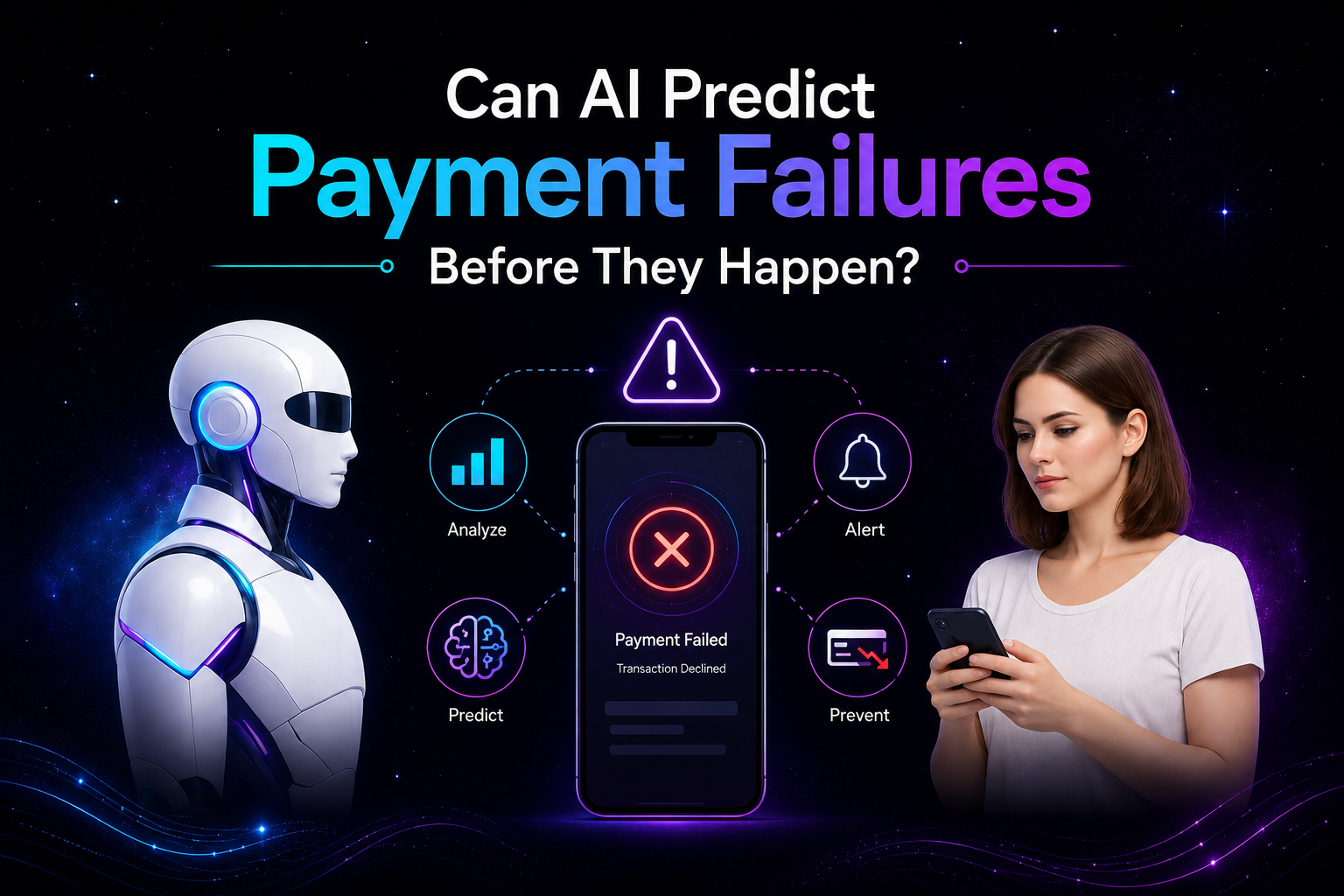
What if someone – or something – could see those payment failures coming before they happen?
Not react. Not retry. Predict.
That’s not science fiction anymore. That’s quietly becoming India’s new financial reality.
The ₹1,000 crore question we don’t ask enough
Every year, Indian businesses lose over ₹1,000 crore to failed transactions. That’s not a statistic – that’s a rent cheque that bounced, a subscription that silently churned, a Kirana store’s daily sale that never reached the bank.
We’ve normalised failure. “UPI down hai.” “Bank server issue.” “Try again.”
But here’s what’s shifting: Payment failures are no longer being treated as random events. Banks, payment gateways, and even small fintechs are starting to use AI to spot the signals before payment failures happen.
Think of it like predicting a tyre burst. You don’t wait for the blowout. You monitor pressure, temperature, road conditions. AI does the same with transactions – but in milliseconds.
How does it actually work?
Let’s keep it real. You don’t need to know neural networks to understand this.
Every digital payment leaves a digital footprint:
- Device used
- Time of day
- Bank balance trend
- Past payment failures and success pattern
- Network latency
- Even the weather (yes, really – rains affect connectivity)
AI models eat this data for breakfast. Over time, they learn patterns that humans can’t see. For example:
*“Users on this specific mobile network, between 7-8 PM, trying to pay above ₹5,000 to a new payee – failure rate 68%.”*
So the next time someone fits that profile, the system can:
- Warn the user (“This might fail – try a different method”)
- Route the payment through a more reliable partner bank
- Retry intelligently, not blindly
- Predict likely payment failures before the user even clicks ‘Pay’
That’s prediction. Not magic. Just math + empathy.
Why this shift is happening right now in India
We’re a UPI-first nation. Over 13 billion transactions a month. But volume has outpaced stability.
Three quiet forces are pushing AI into failure prediction:
1. The churn crisis
If your Netflix payment fails twice, you don’t call customer care – you just leave. For subscription businesses, every payment failure is a silent goodbye. Predicting payment failures changes that. AI prediction reduces churn by up to 30% in early trials.
2. Regulatory pressure
RBI’s recent guidelines on recurring payments (eMandates) have made failure more visible. Banks can’t just shrug anymore. They need data. AI gives them that.
3. Customer patience is gone
We’ve been trained by Zomato and Amazon. We expect things to just work. When a payment fails, we don’t blame the bank – we blame the brand. So brands are now using AI to protect their reputation.
The emotional cost no one talks about
Let’s pause the tech talk.
A payment failure at 2 AM for an emergency medicine order.
A freelancer’s invoice that gets rejected twice, delaying her child’s school fees.
A small D2C brand that loses a bulk order because the payment gateway timed out.
These aren’t “transaction errors.” These are trust fractures.
When AI predicts payment failures, it’s not just saving money. It’s saving someone from that quiet panic. That’s the shift I’m observing – we’re finally treating payments as emotional infrastructure, not just pipes.
But can AI really predict? Or just guess?
Fair question.
Prediction is not 100%. Anyone selling you 100% accuracy is lying. But AI can predict payment failures with 85–95% precision in controlled environments. That’s better than the current “try and pray” model.
What matters more: false positives.
If AI says “this payment will fail” but it actually works – you’ve annoyed a customer for no reason. So the real art is balancing sensitivity and specificity.
The best systems today don’t block. They suggest.
“This payment might fail. Want to try another card?”
That’s honest. That’s human. That’s the kind of AI we actually need.
Real-world example from India
A mid-sized Indian edtech platform (name withheld, but you’ve seen their ads) reduced failed recurring fees by 42% in 4 months. How?
They used a lightweight AI model that checked three things before every auto-debit attempt:
- Was the linked bank account recently changed?
- Had similar amounts failed before for this user?
- Was the user’s network historically unstable at this hour?
If any red flag appeared, they switched the payment attempt to a backup gateway or sent a smart notification to the user. Result: fewer angry parents, fewer uninstalls.
This isn’t Silicon Valley. This is Noida and Bengaluru, quietly getting smarter.
What this means for you (business owner, founder, or just a curious human)
If you run any business with recurring payments – SaaS, agency retainers, membership sites, even a WhatsApp group with paid access – payment failures are silently leaking your revenue.
But here’s the hopeful part: you don’t need a PhD in data science anymore.
Payment gateways like Razorpay, Cashfree, and Stripe now offer basic failure prediction as a feature. Some are free. Some charge a tiny % – far less than what you lose to failures.
The real shift? Moving from reacting to anticipating. That’s the mental model change.
One thing AI can’t predict (yet)
Intent.
AI can see that a card is expired. It can see that a bank server is down. But it cannot know if a customer wanted the payment to fail because they’re unhappy with your service.
So don’t just optimise transactions. Optimise trust.
When a payment failure happens – predicted or not – what you do next matters more than the failure itself. A human follow-up, a sincere SMS, an alternative payment link. That’s still our job.
Reflective conclusion
We’re living through a quiet upgrade of India’s financial nervous system. AI predicting payment failures is not about replacing humans or chasing perfection. It’s about reducing the friction that makes us sigh, worry, or worse – lose faith in digital money.
The technology is here. The question is: will we use it kindly?
Will we use prediction to nudge, not punish? To warn, not blame?
Because the best financial system isn’t the one that never fails. It’s the one that fails less often – and when it does, it picks you up faster than you expected.
That’s the shift I’m noticing. And honestly? It gives me a little hope.
If you’re curious how AI handles bill payments (electricity, water, EMIs) differently, I wrote about that here: AI-Powered Bill Payment APIs: 7 Powerful Shifts.