You’re in Pune, searching for “chai near me,” and the results show a tapri exactly 800 meters away. That local precision? It’s not a coincidence. It’s an IP Geolocation API at work. You open a global clothing brand’s website, and prices automatically show in INR. You try to watch a BBC documentary, and a quiet message appears: “This content is not available in your region.”
For a while, we all assumed this was just “how the internet works.” But lately, it’s started to feel… personal. Almost uncomfortably accurate.
That’s not magic. And it’s not a coincidence. It’s an IP Geolocation API working silently.
That’s an IP Geolocation API – a small but powerful IP Geolocation API – quietly working in the background. And the more you notice it, the more you realize: this tiny piece of technology is fundamentally changing how we experience privacy, personalization, and power online.
Let’s step back and observe what’s actually happening.
The Hook We Don’t Talk About: Why Does Every App Know My City?
Think about the last time you booked a cab, ordered food, or even checked the weather on your phone. Did you actively share your location every single time? Probably not.
And yet – the app knew.
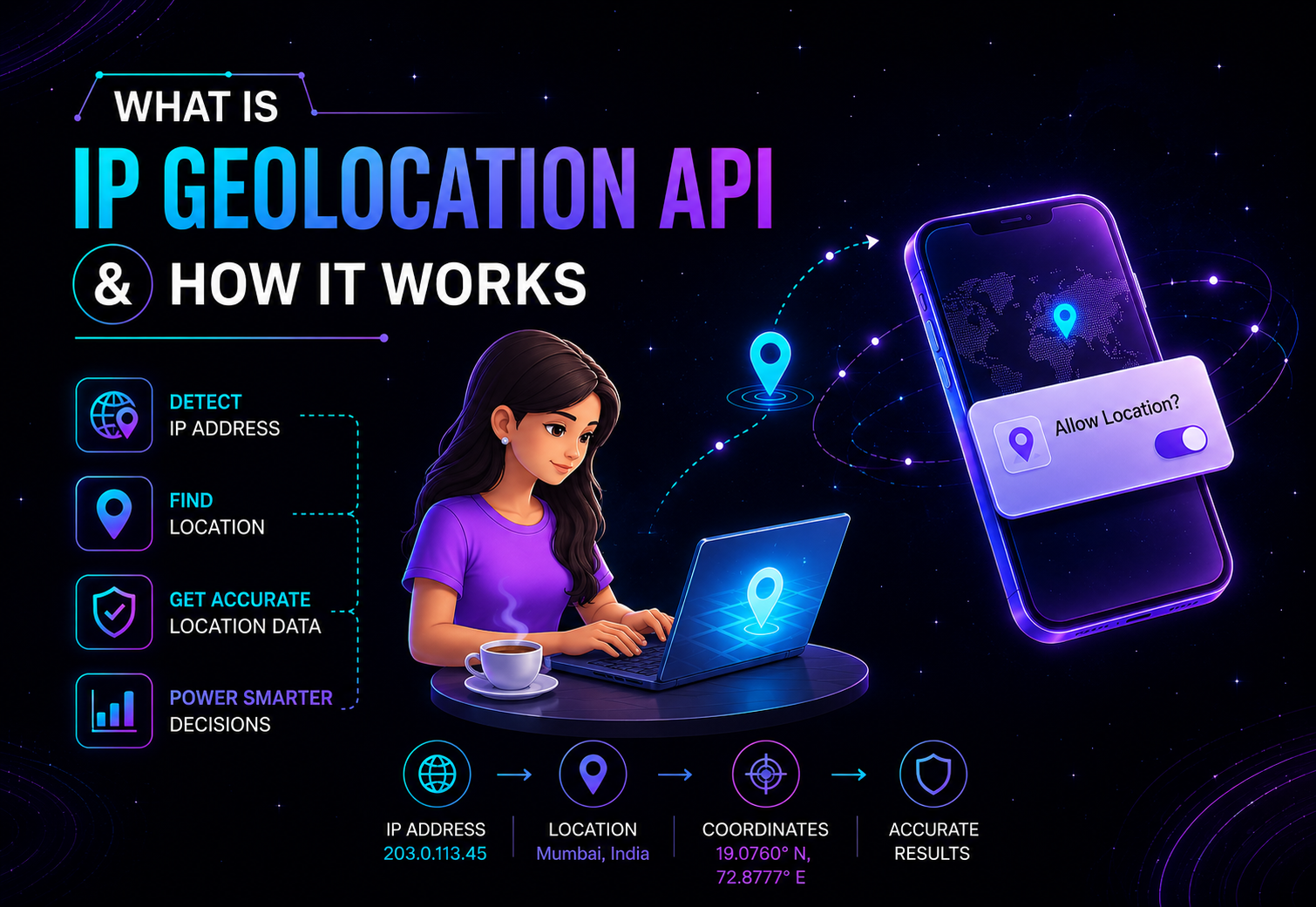
That’s because your device carries an IP address. Think of it like a digital pincode. Every time you visit a website, your IP address is visible to that site’s server. An IP Geolocation API simply takes that pincode and maps it to a physical location – city, region, time zone, even internet service provider.
But here’s what’s quietly unsettling (and brilliant): you never clicked “allow.”
“Wait, so they don’t need my permission?”
Not for IP-based location, no. GPS needs permission. IP geolocation is more like a return address on an envelope – you can’t send a letter without one.
This is the silent shift no one’s really talking about.
How It Actually Works (Without the Technical Overload)
Let’s keep this human.
“Where is this IP address physically located?”
The API responds with data. Sometimes it’s just the country. Sometimes it’s the city, postal code, or even the latitude and longitude.
The Three Layers Most People Never See
- The Database – Companies maintain massive maps of IP ranges and their locations.
- The API Call – A tiny, fast request-response between the website and the database.
- The Action – The website decides what to show you (local prices, regional news, or a block screen).
That’s it. No spy cameras. No creepy tracking (most of the time). Just a digital handshake that happens in milliseconds.
But here’s where it gets emotionally interesting.
The Quiet Trade-Off – Convenience vs. Comfort
Remember the early 2000s internet? Everything was generic. A user in Delhi saw the same homepage as someone in New York. It felt equal – but also useless.
Now, the internet feels like it knows you.
- Local search results actually show nearby stores.
- Banking websites flag logins from a different city automatically.
- Streaming platforms show different libraries depending on where you are.
This is the upside of an IP Geolocation API. It makes the internet usable.
But the discomfort is real too.
You search for something sensitive – medical symptoms, personal finances, relationship advice – and suddenly you wonder: does my city know? Does my ISP know? Does the website keep a log?
That unease isn’t paranoia. It’s the natural reaction to a system that works too well without asking.
Why India Feels This Shift More Than Anywhere Else
India is unique. Not because our technology is different – but because our diversity makes geolocation both powerful and problematic.
Think about it:
- Language changes every 100 km – An IP address from Bengaluru should see Kannada or English? What about a Tamil speaker living in Mumbai?
- E-commerce hyperlocal wars – Flipkart, Amazon, Meesho all use IP geolocation to show different prices, offers, and delivery timelines.
- State-specific regulations – Some states ban certain OTT content, gambling sites, or even loan apps. An IP Geolocation API is how those blocks are enforced.
Here’s the part no one admits: it’s helpful until it’s restrictive.
A young professional in Gurgaon might enjoy personalized ads for co-working spaces. But the same system can also block access to a global learning platform because “your region isn’t licensed.”
That friction isn’t a bug. It’s a feature – just not one designed for your convenience.
The Emotional Layer We Ignore – Digital Belonging
There’s a quiet loneliness to being “located” all the time.
For most people in their 20s and 30s, especially those living away from home for work or study, IP-based localization can feel like a digital leash. It reminds you where you are, even when you’re trying to explore somewhere else.
A student in Lucknow searching for remote jobs in Bangalore. A freelancer in Indore wanting to see global freelance rates. A traveler from Kerala temporarily in Hyderabad.
The IP Geolocation API doesn’t care about your story. It only sees your IP. And that’s fine – it’s a tool, not a judge.
But observing how it makes us feel? That’s worth paying attention to.
What No One Tells You About Accuracy (And Why It Fails)
Here’s an honest flaw.
IP geolocation is not GPS. It cannot find your exact house. At best, it pinpoints your city or a nearby hub. But:
- Mobile networks often show the location of the tower, not you.
- VPNs and proxies completely break it (which is why people use them).
- Work from home has confused millions of IPs – your office IP says Delhi, but you’re sitting in Dehradun.
So the same API that feels “creepily accurate” can also be laughably wrong.
Despite its flaws, the IP Geolocation API has become a non-negotiable tool for modern websites.
And yet, businesses rely on it for:
- Fraud detection
- Compliance (gambling, alcohol, adult content)
- Targeted advertising
- Content licensing
That contradiction – powerful but imperfect – is the reality of the IP Geolocation API.
H2: A Gentle Reflection – The Internet Was Never Neutral
We like to think of the internet as a free, open space.
But the truth is, it was always shaped by geography. Cables, data centers, undersea routes – those are physical. An IP address is just the digital shadow of that physical reality.
What the IP Geolocation API did was simply make that shadow visible.
So the real question isn’t “Is this technology good or bad?”
It’s: Are we comfortable knowing how location shapes our digital lives?
Some days, yes. When it shows the nearest hospital or correct election news.
Other days, no. When it blocks a harmless video or assumes your city defines your preferences.
Neither reaction is wrong. Both are human.
Conclusion (No Advice, Just Observation)
This post wasn’t written to make you switch to a VPN or distrust every website.
It was written because the IP Geolocation API is quietly reshaping how much of the internet sees you.
The internet is no longer a stranger. It now knows where you are – often before you tell it. And whether that feels like safety or surveillance depends entirely on the day, the website, and your mood.
An IP Geolocation API is just code. But the way it makes us feel? That’s real.
And noticing that feeling – without panic, without judgment – might be the most grounded thing we can do right now.