We used to believe that if a signature wasn’t made with blue ink on a stamp paper that smelled like a government archive, it wasn’t real.
For decades, the Indian middle class ran on this anxiety. We would courier documents across states. We would wait. We would pray the ink didn’t smudge.
Then, quietly, Aadhaar eSign happened. And nobody threw a party. But if you look closely-at the loan apps, the remote job contracts, the instant insurance policies-you will see a society that stopped waiting.
At API Galaxy, we don’t just move data. We watch the emotional anatomy of trust change. And digital signing is the biggest shift nobody is discussing over chai.
The Exhaustion of “Physical Presence”
Let’s be honest. The old way wasn’t secure. It was just slow.
Getting a document notarized meant traffic. It meant standing in a line where the pen never had a cap. It meant anxiety about whether the stamp vendor was selling you a real ten-rupee revenue stamp or a photocopy.
Aadhaar eSign solved a problem we had stopped complaining about because we thought it was unfixable: The hassle of being there.
At API Galaxy, we see APIs as bridges. The Aadhaar eSign API is a bridge between your living room and a bank’s server. It validates your 12-digit number, your biometric/OTP, and your consent-all without you putting on pants to go to a registrar.
How Aadhaar eSign Actually Works (No Jargon, Promise)
You don’t need a computer science degree to get this.
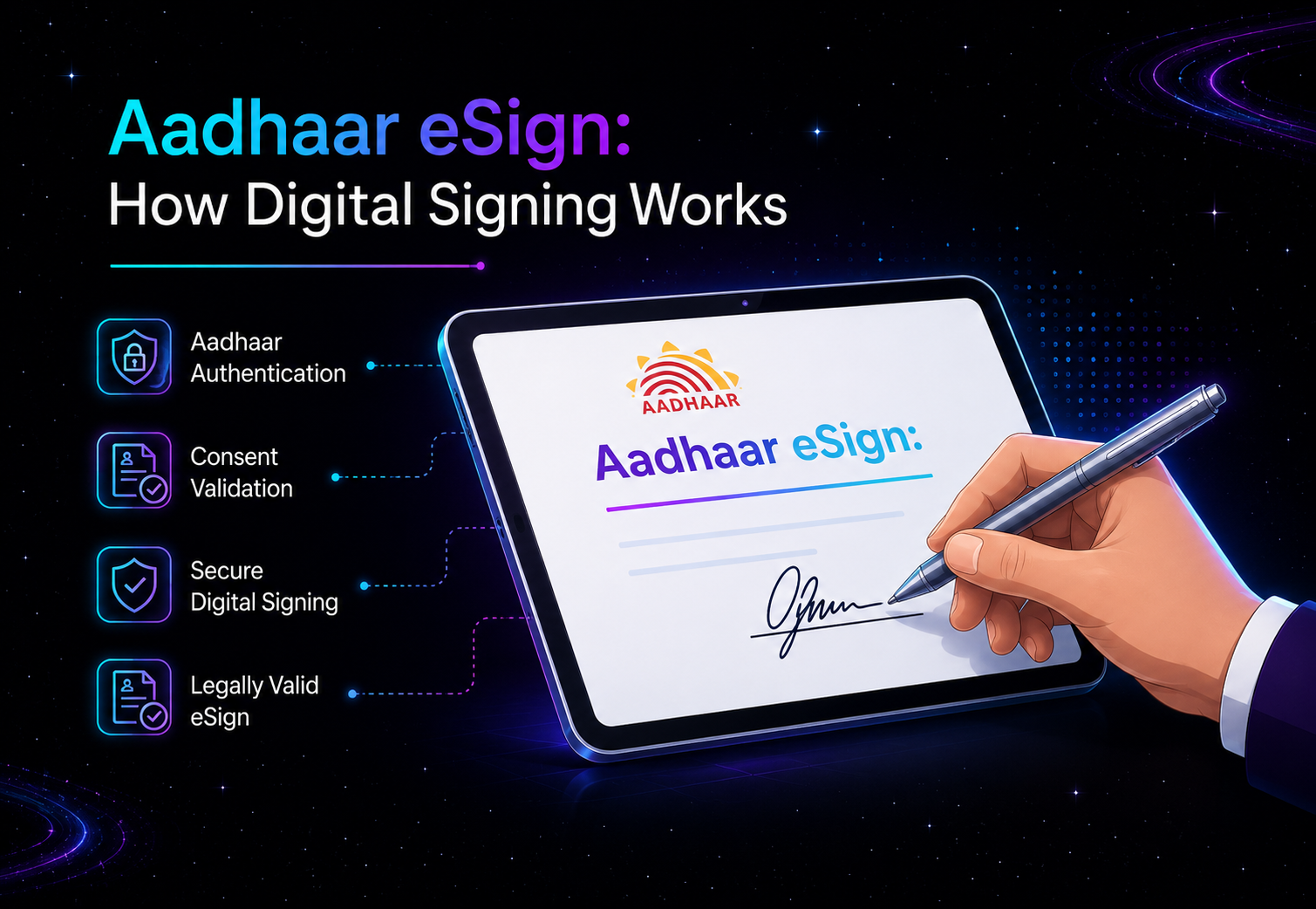
Traditionally, a signature proved intent. A Aadhaar eSign does the same thing, but it uses cryptography instead of kinesthetic pressure.
Here is the simple breakdown:
- You click “Sign.”
- The system asks for your Aadhaar number.
- An OTP goes to your registered mobile.
- You enter the OTP.
- The government’s CIDR (Central Identities Data Repository) validates you.
- A digital signature certificate is generated in the cloud and attached to the document.
For complete legal and technical specifications, refer to the official UIDAI eSign documentation.
That is it. Four seconds. The document is legally binding under the IT Act, 2000.
We at API Galaxy integrate this flow so that startups don’t have to build the crypto infrastructure themselves. We make the complexity disappear so your user just feels relief.
The Trust Paradox: Why We Accept It
Here is the thoughtful part.
For a decade, we were told not to share our Aadhaar. Now, we use Aadhaar eSign to rent apartments. Why the shift?
Because convenience eventually outranks paranoia.
Society realized that the risk of a data leak (low for Aadhaar, relatively speaking) was statistically lower than the risk of losing a physical contract in the monsoon rain. Indian parents used to keep property papers in steel trunks. Their kids keep them in DigiLocker signed via Aadhaar eSign.
This isn’t recklessness. It is adaptation. API Galaxy respects that tension. We don’t just push digital signatures; we ensure the encryption standards make that “leap of faith” logical, not foolish.
If you want to understand how Aadhaar itself is verified before the eSign happens, read our deep dive on the Aadhaar Verification API.
Who is using this right now? (The Invisible APIs)
You might think only “techies” use Aadhaar eSign. Wrong.
- The gig worker: Signing a delivery partner agreement on a Motorola phone at 10 PM.
- The mutual fund investor: Opening an account without a physical disallowed cheque.
- The student: Getting a loan sanction letter in 4 minutes, not 4 days.
Every time you see “E-Sign” on a screen, that is an API call. At API Galaxy, we power those calls for NBFCs, edtechs, and HR platforms. We are the plumbers of the digital India dream. You don’t see us, but you trust the water we provide.
The Silent Fear: “Is this really my signature?”
We have to name the elephant in the room.
Does an OTP feel like you?
When you sign a paper, there is muscle memory. With Aadhaar eSign, there is just a beep. It feels hollow at first. But here is the truth lawyers won’t tell you: Intent is intent.
If you enter your OTP, that is legally more secure than a signature. Anyone can learn to copy your handwriting. Nobody can copy your mobile phone and your retina (if using biometric) simultaneously.
API Galaxy believes in informed consent. We ensure that every Aadhaar eSign integration we build asks the user: “Do you understand what you are signing?” Not just a checkbox. A real pause. Because automation without ethics is just fast fraud.
Conclusion: The death of the “Pending” tray
We are witnessing the end of waiting.
The physical “Inbox” and “Outbox” trays on office desks are becoming coasters. Aadhaar eSign is why your HR can onboard you on a Friday night and you get the offer letter while watching a movie.
At API Galaxy, we aren’t here to sell you a dream. We are here to state a fact: The Indian economy now runs on milliseconds. If your business still relies on wet ink, you aren’t slow. You are invisible.
We provide the API infrastructure for Aadhaar eSign, PAN verification, and bank account validation. We make the government’s tech feel like your tech.
Don’t romanticize the stamp paper. Romanticize the freedom of signing from your sofa.