KYC vs KYB vs CKYC vs Re-KYC are four important verification processes every fintech, NBFC, bank, payment platform, and digital business should understand. In today’s digital economy, choosing the right verification process helps businesses onboard customers or merchants faster, reduce fraud risk, and build more compliant workflows.
This guide explains each term in simple language, highlights the key differences, and shows how businesses across fintech, banking, NBFC, telecom, and e-commerce can apply them effectively.
In this guide, we’ll explore KYC vs KYB vs CKYC vs Re-KYC and understand how each verification process supports secure and compliant onboarding.
What is KYC?
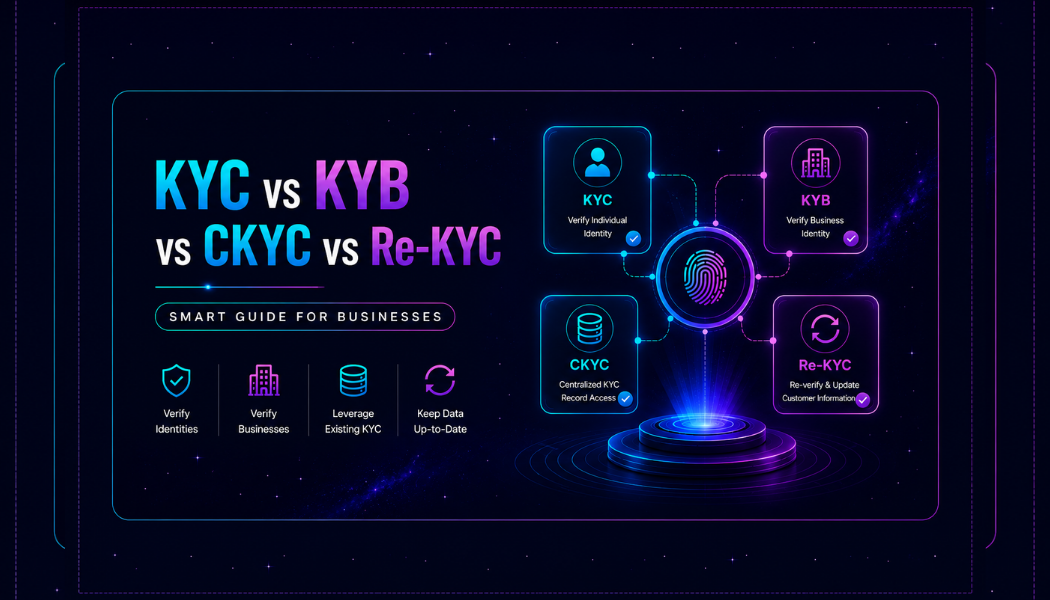
KYC stands for Know Your Customer. It is the process of verifying the identity of an individual before granting them access to financial services or digital platforms.
During kyc, businesses typically check documents such as PAN, Aadhaar, passport, voter ID, or driving licence. The goal is to confirm that the person is who they claim to be and to assess basic risk levels.
KYC is widely used during customer onboarding for bank accounts, digital wallets, insurance policies, loans, and investment apps. It plays a major role in reducing fraud and building trust from the first interaction.
Modern kyc processes often combine document verification, face match, and biometric checks to deliver fast yet secure results.
What is KYB?
KYB stands for Know Your Business. While kyc focuses on individuals, kyb verifies the legitimacy of a company, partnership, or entity.
In a kyb process, businesses check company registration details, GST status, CIN (Corporate Identity Number) from MCA records, director PAN and DIN details, and business bank account verification.
KYB is critical when onboarding merchants, vendors, sellers on marketplaces, or corporate borrowers. It helps platforms assess business risk, detect shell companies, and comply with regulations for B2B relationships.
For payment service providers, lending platforms, and digital marketplaces, strong kyb processes protect against fraud and support safer vendor and merchant ecosystems.
What is CKYC?
CKYC stands for Central KYC. It is a centralized repository managed by CERSAI (Central Registry of Securitisation Asset Reconstruction and Security Interest of India).
Once a customer completes kyc with one regulated financial institution, their records are stored centrally. Other institutions can then fetch these records using a 14-digit KYC Identifier Number (KIN) instead of asking the customer to submit documents again.
CKYC was introduced to reduce duplication, speed up onboarding across banks, NBFCs, insurers, and mutual funds, and improve customer experience. It is particularly useful for businesses that work with multiple financial partners.
According to CERSAI, CKYC helps create a centralized KYC repository that can be accessed by regulated financial institutions, reducing the need for customers to repeatedly submit the same documents. (Source: https://www.ckycindia.in)
What is Re-KYC?
Re-KYC refers to the periodic refresh or update of existing customer information. Regulations require businesses to re-verify customer details at regular intervals based on risk levels.
Typically, high-risk customers may need re-kyc every two years, while medium and low-risk customers follow longer cycles (eight or ten years). It can also be triggered by changes in address, name, or suspicious activity.
Re-kyc helps businesses keep customer data current, maintain accurate risk profiles, and stay compliant with evolving rules. Failing to complete re-kyc on time can lead to account restrictions.
Understanding KYC vs KYB vs CKYC vs Re-KYC becomes especially important when designing scalable compliance workflows.
KYC vs KYB vs CKYC vs Re-KYC: Key Differences
To choose the right onboarding process, businesses must first understand the differences between KYC vs KYB vs CKYC vs Re-KYC and where each verification requirement applies.
Here’s a clear comparison to help teams quickly understand when to use each process:
| Aspect | KYC | KYB | CKYC | Re-KYC |
|---|---|---|---|---|
| Full Form | Know Your Customer | Know Your Business | Central KYC | Periodic KYC Refresh |
| Used for | Individuals | Companies & entities | Re-using existing KYC records | Updating existing customers |
| Main Purpose | Verify personal identity | Verify business legitimacy | Avoid repeated KYC | Keep customer data current |
| Common Checks | PAN, Aadhaar, Face Match, DL | GST, CIN, Director PAN, Bank | Fetch records via KIN | Updated PAN, Aadhaar, Address |
| Who Needs It | Banks, fintechs, insurers | Marketplaces, lenders, PSPs | Regulated financial entities | All entities with customer base |
| Business Use Case | App onboarding, loan applications | Merchant & vendor onboarding | Cross-institution onboarding | Periodic compliance & risk review |
This KYC vs KYB vs CKYC vs Re-KYC comparison highlights how each verification process addresses a different stage of the customer or business lifecycle.
Why Businesses Need These Verification Processes
A clear understanding of KYC vs KYB vs CKYC vs Re-KYC helps businesses create more efficient onboarding, compliance, and risk management strategies.
Strong verification processes deliver multiple benefits:
- Faster onboarding: Digital checks reduce waiting time from days to minutes.
- Fraud reduction: Proper kyc and kyb help catch suspicious entities early.
- Regulatory readiness: Following current guidelines helps businesses stay prepared for audits.
- Customer trust: Transparent and secure processes improve user confidence.
- Reduced manual work: Automated workflows free up compliance and operations teams.
- Scalable digital growth: Reliable verification supports expansion across new products and markets.
For fintech companies, NBFCs, payment platforms, and digital marketplaces, these processes are no longer optional — they are core to sustainable operations.
How APIs Help Simplify KYC, KYB, CKYC and Re-KYC
Modern verification platforms use APIs to automate multiple stages of KYC vs KYB vs CKYC vs Re-KYC workflows.
Verification APIs allow businesses to automate identity, document, and business checks instead of relying on manual processes.
APIs can integrate PAN verification, Aadhaar checks, GST validation, CIN lookup, bank account verification, face match, and CKYC search into existing onboarding flows. This improves speed, accuracy, and scalability while reducing operational overhead.
API Galaxy is an API infrastructure provider that offers secure and high-performance solutions for verification workflows. Businesses use these APIs to digitize and streamline kyc, kyb, document verification, business verification, and account validation processes. The result is faster integration, reliable uptime, and cleaner developer experience for product and engineering teams.
By leveraging well-designed verification APIs, companies can build flexible onboarding systems that adapt to different risk levels and regulatory needs without rebuilding infrastructure every time rules change.
Common Business Use Cases
Here are practical examples where these processes are applied:
- Fintech onboarding: Completing kyc before activating digital wallets or investment accounts.
- Lending platforms: Performing kyb on borrowers and kyc on individual applicants.
- Payment service providers: Running kyb during merchant onboarding.
- NBFC customer verification: Combining kyc and re-kyc for loan customers.
- Merchant onboarding: Using kyb for marketplaces and ONDC sellers.
- Vendor verification: Conducting kyb before adding suppliers to procurement systems.
- Telecom user verification: Applying kyc for new SIM activations.
- Digital marketplaces: Running both kyc for users and kyb for sellers.
Each use case benefits from choosing the right mix of kyc, kyb, ckyc, or re-kyc based on the customer type and risk profile.
Common Mistakes Businesses Should Avoid
Many compliance challenges arise when organizations misunderstand the purpose of KYC vs KYB vs CKYC vs Re-KYC within their onboarding process.
- Treating kyc and kyb as the same process.
- Ignoring scheduled re-kyc until regulators send notices.
- Depending entirely on manual verification at scale.
- Poor data handling that leads to compliance gaps.
- Not designing verification workflows that can scale with business growth.
Avoiding these mistakes helps teams build more resilient and future-ready onboarding systems.
Conclusion
Understanding KYC vs KYB vs CKYC vs Re-KYC is essential for any business operating in fintech, banking, lending, payments, or digital services.
By selecting the right verification approach and supporting it with reliable technology, businesses can reduce risk, improve speed, and deliver better customer experiences. As digital adoption grows, clear knowledge of these processes will remain a competitive advantage.
API Galaxy supports businesses by providing verification API infrastructure that helps automate and streamline these workflows, allowing teams to focus on growth rather than manual operations.
As digital onboarding continues to evolve, understanding KYC vs KYB vs CKYC vs Re-KYC will remain critical for businesses aiming to balance compliance, security, and customer experience.
Frequently Asked Questions (FAQs)
1. What is the difference between KYC and KYB?
KYC verifies individual customers while KYB verifies businesses, companies, directors, and related documents such as GST and CIN.
2. What is CKYC?
CKYC (Central KYC) is a centralized repository where one-time kyc records are stored so other regulated entities can fetch them using a KIN instead of repeating the full process.
3. What is Re-KYC?
Re-KYC is the mandatory periodic update of existing customer information based on risk level and regulatory timelines.
4. Is KYB required for businesses?
Yes, kyb is required when onboarding merchants, vendors, corporate borrowers, or marketplace sellers to meet compliance and risk standards.
5. Why is KYC important in fintech?
KYC helps fintech companies reduce fraud, meet regulatory requirements, build customer trust, and create safe digital onboarding experiences.
6. How do APIs help with KYC and KYB?
Verification APIs automate document checks, business validation, face match, and record fetching, making onboarding faster, more accurate, and easier to scale.
7. Can Re-KYC be automated?
Yes. Using verification APIs, businesses can trigger and complete re-kyc checks at scale with minimal manual intervention.
8. Which businesses need KYC, KYB, CKYC, or Re-KYC?
Banks, NBFCs, fintechs, payment platforms, lending companies, insurance firms, digital marketplaces, telecom providers, and HR tech platforms all require one or more of these processes depending on their operations.