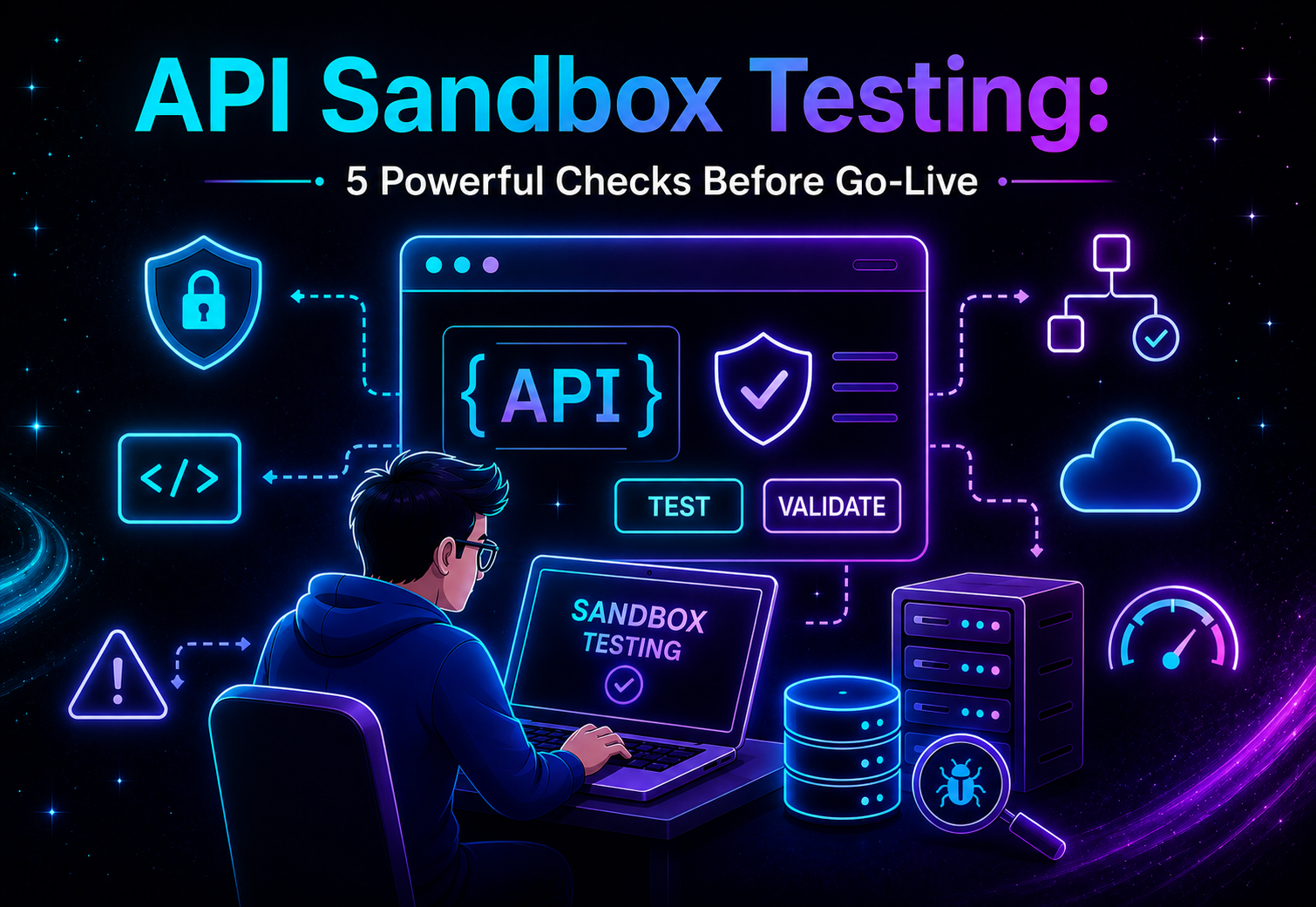
API Sandbox Testing often feels like a formality when teams are racing toward launch deadlines. The product is ready, stakeholders are waiting, marketing campaigns are scheduled, and everyone wants to see the first real transaction go through. Yet some of the most expensive API failures don’t happen because the API itself is broken. They happen because critical scenarios were never tested before the first live API call.
Across India’s rapidly expanding digital economy, businesses now rely on APIs for everything from customer onboarding and identity verification to payments, recharges, travel bookings, and bill payments. Whether it’s a fintech startup processing thousands of UPI transactions or a growing platform verifying customer identities, reliable API infrastructure has become a business necessity.
This is why API Sandbox Testing matters more than ever.
Companies working with platforms like API Galaxy understand that customer trust isn’t built when an API works once. It’s built when systems continue to perform consistently under real-world conditions. Before any live API call reaches production, there are several critical checks every team should complete.
Why API Sandbox Testing Matters More Than Ever
India’s digital infrastructure has evolved dramatically over the last few years. Customers expect instant onboarding, real-time payments, immediate status updates, and seamless digital experiences.
According to NPCI’s official UPI statistics, digital payment volumes continue to grow significantly across India.
As transaction volumes rise, even small API failures can create larger business problems. Failed verifications, delayed callbacks, incorrect responses, or authentication issues can directly affect customer trust.
This is where API Sandbox Testing becomes essential.
For companies using modern platforms like API Galaxy, sandbox environments provide a safe space to validate integrations before real customer data and transactions are involved. It helps teams identify issues early while reducing operational risk.
API Sandbox Testing Check #1: Authentication & Credential Validation
Verify Every Authentication Scenario
One of the most common reasons APIs fail after deployment is improper authentication testing.
During API Sandbox Testing, teams should validate:
- Correct API keys
- Invalid API keys
- Expired tokens
- Missing credentials
- Access permission restrictions
- Token refresh mechanisms
Many developers test only successful authentication flows. However, real-world environments rarely operate perfectly.
Imagine integrating a KYC Verification API from API Galaxy. If authentication errors aren’t properly handled, customers may face failed onboarding attempts even when their information is correct.
Effective API Sandbox Testing ensures every authentication scenario is validated before production deployment.
API Sandbox Testing Check #2: Request & Response Validation
Test Every Possible Response Type
Successful responses are only one part of the equation.
A comprehensive API Sandbox Testing process should examine:
- Success responses
- Validation failures
- Missing parameters
- Incorrect request formats
- Partial responses
- Empty data scenarios
Many startups focus on happy-path testing. Unfortunately, customers rarely follow happy paths.
For example, while integrating a Recharge API through API Galaxy, teams should verify how the system behaves when invalid operator details, incorrect numbers, or incomplete requests are submitted.
This level of API Sandbox Testing helps prevent unexpected production issues.
API Sandbox Testing Check #3: Error Handling & Failure Scenarios
Simulate Real-World Failures
No infrastructure is immune to temporary disruptions.
Good API Sandbox Testing should intentionally create failure conditions such as:
- Timeout errors
- Network interruptions
- Server unavailability
- Invalid customer inputs
- Third-party dependency failures
- Unexpected response delays
These situations are not rare. They’re part of operating digital systems at scale.
A business using API Galaxy’s payment infrastructure or verification services should understand how applications react when external services become temporarily unavailable.
The goal of API Sandbox Testing isn’t to prove everything works perfectly. It’s to prove the system can recover gracefully when things don’t.
API Sandbox Testing Check #4: Transaction & Workflow Validation
Modern APIs are rarely standalone services.
Most businesses rely on connected workflows involving multiple systems.
Examples include:
- Customer onboarding
- PAN verification
- Aadhaar verification
- Bill payments
- Mobile recharges
- Travel bookings
- UPI transactions
When using services from API Galaxy, teams should validate complete workflows rather than individual endpoints.
What Should Be Tested?
- Transaction initiation
- Status updates
- Callback responses
- Webhook delivery
- Reconciliation processes
- Retry mechanisms
- Final transaction confirmation
Strong API Sandbox Testing ensures every step behaves exactly as expected before real customers interact with the system.
API Sandbox Testing Check #5: Scalability & Performance Testing
Can Your Integration Handle Growth?
One transaction is easy.
Ten thousand simultaneous transactions are different.
Many startups experience growth faster than expected. Promotional campaigns, festive seasons, and viral customer adoption can dramatically increase API traffic.
This is why API Sandbox Testing should include:
- Load testing
- Concurrent request testing
- Peak traffic simulation
- Response time monitoring
- Resource utilization analysis
According to McKinsey, APIs are increasingly becoming foundational infrastructure for digital businesses.
Organizations using API Galaxy’s scalable API infrastructure can evaluate how integrations behave under increasing demand before moving to production.
Comprehensive API Sandbox Testing helps teams prepare for future growth instead of reacting to performance issues later.
Sandbox vs Production Environment
| Area | Sandbox Environment | Production Environment |
|---|---|---|
| Data | Test Data | Real Data |
| Risk Level | Low | High |
| Transactions | Simulated | Actual |
| User Impact | None | Direct Customer Impact |
| Error Cost | Minimal | Potential Revenue Loss |
| Compliance Impact | Testing Only | Real Regulatory Requirements |
How API Galaxy Helps Teams Prepare for Production
As businesses become increasingly API-driven, backend reliability often matters more than frontend design.
API Galaxy provides businesses with access to:
- KYC Verification APIs
- Recharge APIs
- Bill Payment APIs
- Travel APIs
- UPI infrastructure solutions
- Fraud detection systems
- Real-time dashboards
- Secure digital transaction systems
- Developer-friendly APIs
- Scalable API infrastructure
Teams using API Galaxy can leverage sandbox environments to perform extensive API Sandbox Testing before production deployment.
Whether it’s onboarding customers, processing payments, managing recharges, or handling travel bookings, API Galaxy helps organizations create reliable workflows.
For growing startups and enterprises, API Galaxy serves as a technology partner focused on stability, security, and scalability.
Conclusion
The pressure to launch quickly is understandable. Every startup, product team, and developer wants to move fast.
But reliability is rarely created at launch.
It’s built through careful preparation.
Effective API Sandbox Testing helps teams uncover hidden issues before they affect customers, revenue, and trust. Authentication problems, response validation errors, workflow failures, and performance bottlenecks are all easier to fix before the first live API call.
As India’s digital ecosystem continues to grow, businesses are increasingly realizing that strong infrastructure matters more than flashy features.
Platforms like API Galaxy enable organizations to approach production with greater confidence through secure, scalable, and developer-friendly API ecosystems.
Ultimately, API Sandbox Testing isn’t just a technical step. It’s one of the smartest investments a business can make before going live.
Continue Reading
As digital transactions continue to grow, identity verification has become far more than a compliance requirement. It now plays a direct role in customer trust, fraud prevention, onboarding speed, and overall user experience. Businesses that understand the importance of reliable verification infrastructure are often better positioned to scale securely in today’s digital-first environment.
Read next: Verification APIs: The Backbone of Secure Digital Identity in a Trust-First Economy
Explore how modern verification APIs are helping businesses strengthen digital trust, reduce fraud risks, streamline customer onboarding, and build secure digital experiences at scale.