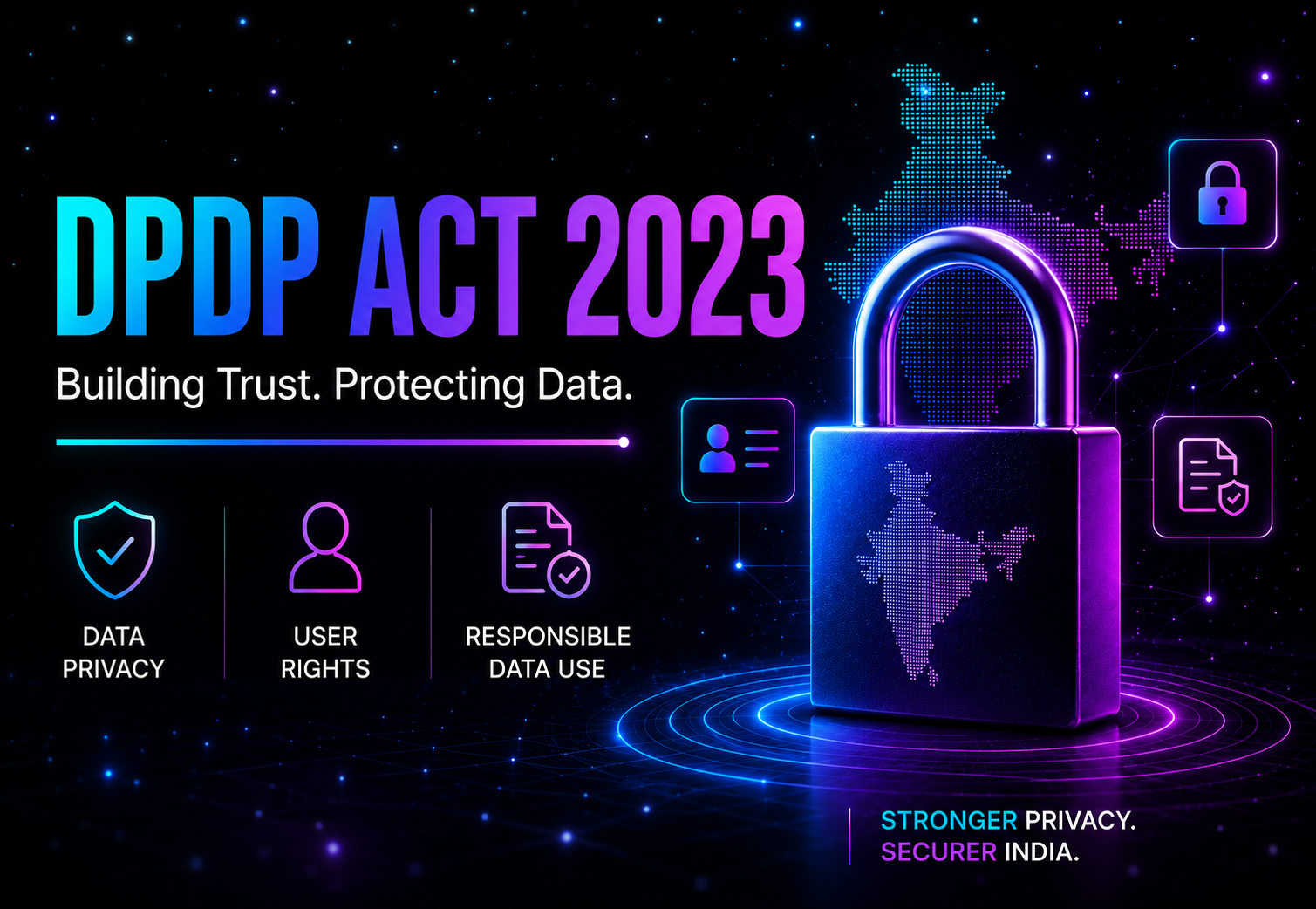
Digital Personal Data Protection (DPDP) Act, 2023
There was a time when privacy policies were something most people ignored. They were long, difficult to understand, and often accepted with a single click.
That mindset is changing.
Today, every OTP, every KYC verification, every customer registration, every onboarding form, and every business application involves personal data. Whether someone is opening a bank account, booking a flight, applying for a loan, or signing up for a digital platform, they’re trusting businesses with information that represents their identity.
DPDP Act 2023 arrives at a time when India is rapidly becoming one of the world’s largest digital economies. It isn’t just another compliance requirement. It reflects a broader shift in how businesses are expected to collect, process, store, and protect personal data.
For startups, fintech companies, enterprises, and digital platforms, compliance is no longer just a legal checkbox. It is becoming part of customer trust.
Why DPDP Act 2023 Matters More Than Ever
India’s digital ecosystem has expanded dramatically over the past few years.
Millions of people now complete financial transactions, identity verification, shopping, healthcare consultations, travel bookings, education, and government services entirely online.
According to NPCI, UPI continues to process billions of digital transactions every month, highlighting the scale at which personal information moves through digital systems.
Every digital interaction creates responsibility.
Businesses no longer manage only customer experiences. They also manage customer data.
That is exactly where DPDP Act 2023 becomes important.
Understanding DPDP Act 2023 in Simple Language
The Digital Personal Data Protection (DPDP) Act, 2023 establishes a legal framework for processing digital personal data in India.
Its primary objective is straightforward:
Give individuals greater control over their personal data while ensuring organizations handle that data responsibly.
The Act defines responsibilities for organizations that collect personal information and provides rights to individuals whose data is being processed.
The official legislation is available through the Government of India.
Rather than treating privacy as an afterthought, DPDP Act 2023 encourages businesses to build privacy into their everyday operations.
DPDP Act 2023 and India’s Shift Toward Trust-Based Digital Services
Customers today are far more aware of privacy than they were even a few years ago.
Data breaches, spam calls, phishing attempts, identity theft, and online fraud have changed public perception.
People increasingly ask questions like:
- Why does this company need my information?
- How long will my data be stored?
- Who can access it?
- Can I request deletion?
These are no longer concerns limited to large enterprises.
Small startups, fintech platforms, e-commerce businesses, travel companies, telecom providers, healthcare applications, and SaaS businesses all collect personal information.
As India becomes increasingly digital, trust is becoming one of the strongest competitive advantages.
What Responsibilities Does DPDP Act 2023 Place on Businesses?
Collect Only Necessary Information
Businesses should collect only the information genuinely required to provide their services.
Unnecessary data collection increases both compliance burden and security risks.
Obtain Clear User Consent
Consent should be informed, specific, and easy to understand.
Users should know:
- What data is being collected
- Why it is collected
- How it will be used
- How they can withdraw consent
Protect Personal Information
Organizations are expected to implement reasonable security safeguards to prevent unauthorized access or misuse.
This includes secure infrastructure, encryption, controlled access, and monitoring.
For businesses integrating identity verification into onboarding workflows, platforms like API Galaxy support secure verification processes through developer-friendly APIs designed for modern digital ecosystems.
Respect User Rights
Individuals have the right to:
- Access their information
- Request corrections
- Withdraw consent
- Request deletion where applicable
These rights encourage transparency between businesses and customers.
Why Verification Infrastructure Matters Under DPDP Act 2023
Compliance isn’t only about legal documentation.
It also depends on how data flows through your technology systems.
Many organizations still rely on manual verification processes involving spreadsheets, email attachments, or multiple disconnected tools.
These approaches increase operational complexity and the risk of human error.
Modern API-driven verification infrastructure offers a more structured approach.
For example, API Galaxy provides secure Individual Verification APIs and Business Verification APIs that help organizations verify identities efficiently while maintaining standardized workflows.
Instead of moving customer information across multiple systems manually, businesses can automate verification within secure application environments.
This supports both operational efficiency and stronger governance.
Why API-First Systems Are Becoming the New Standard
Modern applications rarely function in isolation.
Digital platforms rely on APIs for:
- Identity verification
- Payment processing
- Authentication
- Customer onboarding
- Business verification
- Fraud monitoring
As organizations scale, manual processes become increasingly difficult to manage.
Developer-friendly platforms such as API Galaxy help businesses integrate verification capabilities into existing applications without disrupting customer experiences.
Scalable API infrastructure also reduces repetitive manual work, improves consistency, and supports compliance objectives.
DPDP Act 2023 Is Also About Better Customer Experience
Many businesses think privacy slows growth.
In reality, the opposite is often true.
Customers are more likely to trust businesses that clearly explain:
- Why information is required
- How data is protected
- How privacy is respected
Transparency reduces uncertainty.
Trust improves conversions.
Responsible data handling strengthens long-term relationships.
This is why many digital-first companies are investing in secure onboarding, verification APIs, consent management, and privacy-focused architecture.
API Galaxy fits naturally into this shift by enabling secure verification workflows that support responsible digital onboarding.
How Startups Can Prepare for DPDP Act 2023
Startups don’t necessarily need massive compliance teams.
They do need thoughtful systems.
A practical starting point includes:
Audit Existing Data Collection
Review every customer touchpoint.
Ask whether each piece of information is genuinely required.
Secure Verification Processes
Avoid sharing identity documents through unsecured communication channels.
Using solutions such as API Galaxy’s Individual Verification API enables structured verification while minimizing unnecessary manual handling.
Train Internal Teams
Privacy is not only an IT responsibility.
Product managers, developers, customer support teams, compliance officers, and leadership all play important roles.
Build Privacy Into Product Design
Rather than adding compliance later, include privacy considerations during product development.
Privacy by design often reduces future operational complexity.
Why This Conversation Will Only Become More Important
India’s digital economy continues to grow across banking, fintech, telecom, travel, healthcare, education, and e-commerce.
As this ecosystem expands, data protection will become a defining characteristic of trustworthy businesses.
According to NASSCOM, digital transformation continues to reshape how Indian enterprises build technology and customer experiences.
The organizations that succeed won’t simply collect more data.
They’ll demonstrate that they can protect it responsibly.
This is where secure infrastructure providers like API Galaxy contribute meaningfully, offering scalable verification APIs, reliable identity verification systems, and developer-friendly integrations that support businesses adapting to evolving privacy expectations.
Final Thoughts
DPDP Act 2023 represents much more than a regulatory milestone.
It reflects a cultural shift.
Customers increasingly expect transparency.
Businesses increasingly rely on digital identity.
Technology increasingly depends on secure APIs.
The companies that treat privacy as part of customer experience—not merely legal compliance—are likely to earn stronger trust in the years ahead.
Solutions like API Galaxy won’t replace good governance, but they can help organizations build secure verification workflows, streamline onboarding, and strengthen digital infrastructure in a way that aligns with modern privacy expectations.
As India’s digital future continues to evolve, responsible data practices will no longer be optional. They will become part of what defines a trustworthy business.
Related Articles
It reflects a cultural shift.
Understanding the DPDP Act 2023 is only one part of building a compliant digital business. Equally important is knowing which verification process fits your use case. Explore our detailed guide on KYC vs KYB vs CKYC vs Re-KYC to understand the role each framework plays in secure digital onboarding.