Introduction
Imagine a food delivery executive is onboarded within minutes because their identity is instantly verified. Or a family renting a car for a weekend trip completes the booking without standing in line for manual checks. This is the reality enabled by digital Driving License Verification. As India’s economy digitizes rapidly, verifying a customer’s or partner’s identity is no longer a luxury; it is a necessity for compliance and trust.
However, not all verification methods are equal. Businesses often face a crucial choice: should they choose a basic Driving License Verification to keep things simple, or do they need the comprehensive depth of a “Plus” plan to meet high-stakes compliance demands? This decision impacts fraud rates, customer experience, and regulatory standing. This guide breaks down the difference between Lite and Plus verification tiers, offering a clear roadmap for Indian businesses navigating this critical aspect of digital identity.
What is Driving License Verification?
At its core, Driving License Verification is the process of validating the authenticity of an Indian driving license. It involves checking key data points against official government records to confirm that the document is genuine and the holder’s identity is legitimate.
Modern verification goes far beyond a simple visual check. Today, Driving License Verification usually involves an API (Application Programming Interface) that acts as a bridge between a business’s platform and government databases like the Ministry of Road Transport and Highways (MoRTH) or Parivahan. When a user submits their license details, the API instantly queries these official sources to verify the information.
This digital process offers significant advantages:
- Speed: Results are often returned in seconds.
- Accuracy: It eliminates human error associated with manual checks.
- Scale: Businesses can verify thousands of licenses simultaneously without additional overhead.
- Compliance: It helps meet KYC (Know Your Customer) and AML (Anti-Money Laundering) regulations.
Businesses use Driving License Verification to screen delivery partners, confirm customer identities for insurance policies, or ensure the driver for a rented vehicle is legally authorized.
Why Driving License Verification Matters More Than Ever in India
The significance of Driving License Verification in India today is multifaceted, driven by regulatory mandates and an evolving digital ecosystem.
1. Regulatory Compliance
RBI guidelines, especially those concerning KYC and AML, require financial institutions and fintech companies to ensure the identity of their customers. A valid driving license is recognized as a valid Officially Valid Document (OVD). Failure to perform proper verification can lead to heavy penalties and reputational damage.
2. Fraud Prevention
The digital economy has opened new avenues for fraud. Fake identities and forged documents are used to open fraudulent accounts, claim false insurance, or bypass hiring protocols. Driving License Verification acts as the first line of defense, ensuring businesses deal with real people and valid documents.
3. The Gig Economy
India’s gig economy is booming. Platforms like Zomato, Swiggy, and Uber rely heavily on a network of driver partners. Verifying these driver identities through Driving License Verification is crucial for brand trust and passenger safety. It ensures that the person behind the wheel is licensed and legally permitted to operate a vehicle.
4. Seamless Onboarding
In a competitive market, a smooth customer experience is a major differentiator. Driving License Verification via API allows businesses to onboard customers almost instantly, reducing friction and improving conversion rates. For example, a travel aggregator can complete a booking in minutes, without the need for scanning and uploading documents, by fetching the driver’s details during the reservation process.
5. Digital Public Infrastructure
India’s push for a digital-first economy, championed by initiatives like Digital India, necessitates secure digital identity infrastructure. Digital Verification APIs are the backbone of this infrastructure, enabling the secure flow of information between government bodies, banks, and private enterprises.
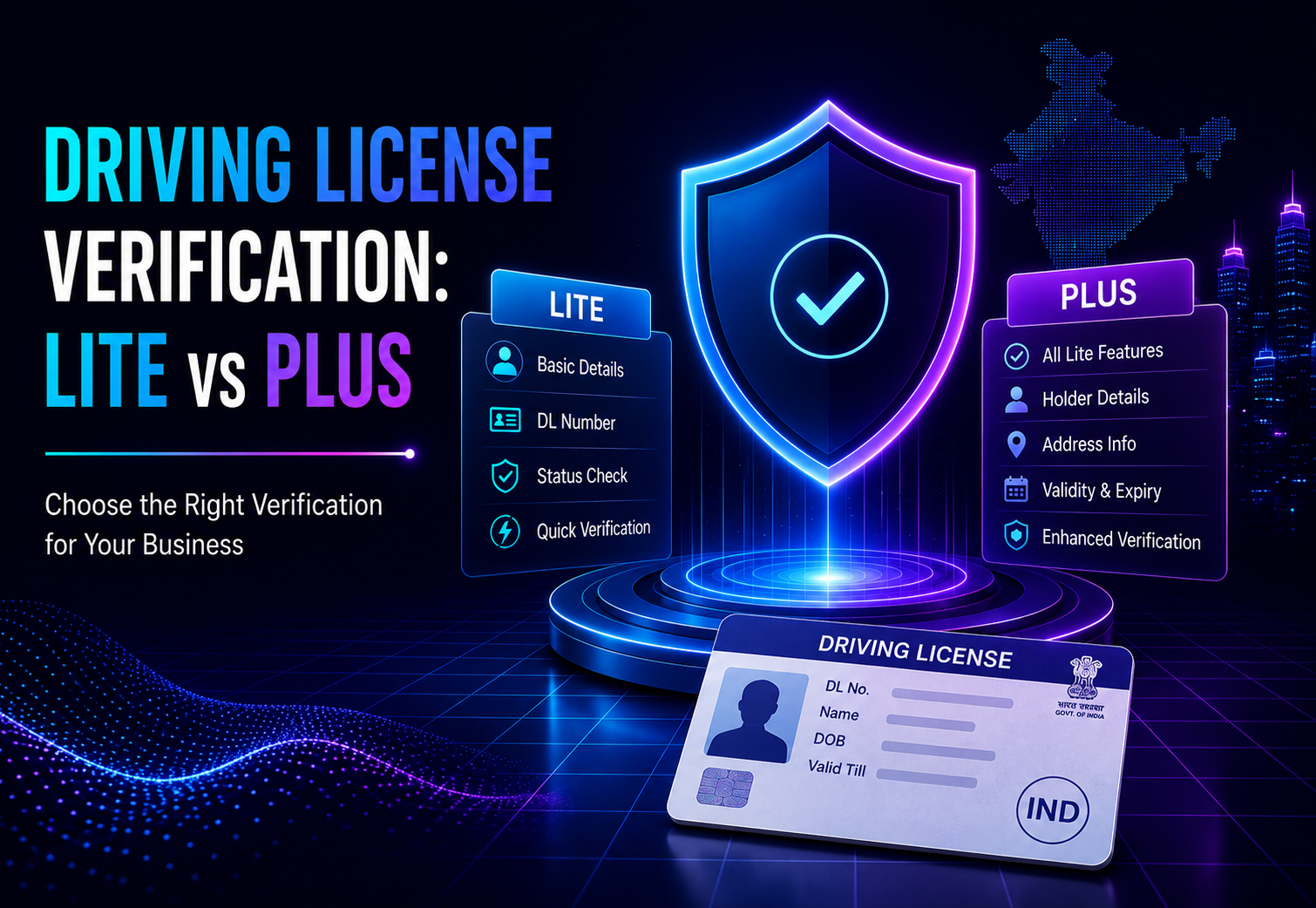
Driving License Verification Lite vs Plus
Choosing between “Lite” and “Plus” verification plans is a critical decision. The “Lite” plan is designed for high-volume, low-friction use cases, while “Plus” is built for scenarios requiring the highest level of assurance. Here is a direct comparison of the typical features.
| Feature | Lite | Plus |
|---|---|---|
| Name Validation | Basic match | Exact match checks |
| DL Number Validation | Syntax and format check | Real-time database validation |
| Date of Birth | Validation against records | Cross-checked with age eligibility |
| Father’s Name | Limited availability | Available (if supported by data source) |
| Address Details | Limited (City/State) | Comprehensive (full address from records) |
| Driving License Status | Check (Active/Expired) | Status + Validation of class of vehicle |
| Data Depth | Basic data points | Detailed, deeper field validation |
| Best Use Case | Low-risk onboarding & volume checks | High-trust verification & compliance |
Lite Verification Explained
A Driving License Verification Lite plan is generally focused on a “match/no-match” type of check. It processes basic inputs like the driver’s name and the license number to confirm if the data exists in the government database.
1. Basic Validation
Lite APIs typically run mathematical checks on the Driving License number to ensure it conforms to the standard format issued by the RTO. This quickly filters out invalid numbers or entirely fake inputs.
2. Essentials Check
It confirms the license holder’s name and date of birth to ensure they are genuine. This is useful for a surface-level KYC check where the risk of fraud is low. For instance, a taxi aggregator might use this to quickly verify hundreds of new driver applicants daily.
3. High Volume, Low Cost
Lite plans are designed for scale. They are generally more cost-effective per API call, making them ideal for businesses that need to run high-volume checks without a significant financial burden. This fits perfectly with the “minimum compliance” approach for routine operations.
Plus Verification Explained
The “Plus” plan for Driving License Verification digs deeper, pulling detailed information from the official records to provide a comprehensive identity profile. This is best suited for high-stakes financial and compliance needs.
1. Detailed Data Retrieval
Plus verification typically returns more data fields. This often includes the holder’s full address, the class of vehicle they are authorized to drive, and sometimes even the license issue and expiry date. For a car rental company, verifying the vehicle class is vital to ensure the driver is licensed for the type of car they are renting.
2. Enhanced Fraud Detection
Beyond basic validation, Plus plans often have access to more rigorous fraud detection algorithms. They can detect inconsistencies in the data, such as a name mismatch between the license and other identity documents.
3. Compliance Ready
For financial institutions, NBFCs, and insurance companies, the “Plus” plan offers the depth required to meet strict regulatory requirements. The detailed response provides an “audit trail” of the verification process.
4. Status Tracking
Plus plans are more robust in their tracking. They can check if a license has been suspended or revoked, something a Lite plan might miss. This is critical for high-value insurance claim processing or employment background verification.
When Should Businesses Choose Lite?
Choosing the right Driving License Verification plan depends on the risk tolerance and specific operational requirements of the business.
- During Initial Onboarding: A “Lite” verification is suitable for low-risk onboarding, such as a quick check of a user registering on a general e-commerce platform.
- High-Volume Checks: For large-scale verification, like confirming credentials for gig-economy worker registrations, the efficiency and lower cost of Lite are beneficial.
- No Deep Address Requirements: If you don’t need a detailed physical address (e.g., a delivery app that only needs to confirm the driver’s identity), Lite is sufficient.
- Cost Optimization: Startups or businesses with tight budgets and a high volume of transactions may find Lite to be the most economical way to meet baseline compliance.
When Should Businesses Choose Plus?
The “Plus” verification plan is essential when errors or fraudulent activity could have significant consequences.
- High-Value Financial Transactions: For disbursing loans, opening high-value bank accounts, or processing large insurance claims, the detail of a Plus plan is necessary to mitigate risk.
- Strict Compliance Mandates: NBFCs and large financial institutions often require additional details like full address to complete their KYC and AML obligations. The depth of Plus ensures they collect the necessary data.
- Immigration and Background Checks: For HR departments verifying key executives or for high-level security clearances, the added depth of a Plus plan is crucial.
- Ride-Sharing and Fleet Management: To ensure compliance with transport regulations and safety, verifying the class of vehicle and the exact license validity period is vital.
Industries Using Driving License Verification
A wide range of sectors depend on robust Driving License Verification APIs to automate operations and ensure compliance.
- Fintech & Banking: For opening accounts and facilitating digital lending.
- Insurance: For processing claims and onboarding new policyholders.
- NBFCs: For verifying client identities in non-banking financial companies.
- Vehicle Rental & Taxi Services: For ensuring drivers are licensed to operate specific vehicles.
- Food & Delivery Apps: To verify delivery partners for safety and accountability.
- Travel & Mobility Platforms: For booking vehicles and verifying driver details.
- Human Resources (HR) & Background Verification: For pre-employment checks, especially for roles involving driving.
- Logistics & Fleet Management: For managing driver pools and ensuring compliance.
- Gig Economy & Ride Sharing: For onboarding freelancers and driver partners.
- Quick Commerce & E-commerce: For verifying delivery agents and last-mile delivery partners.
Common Driving License Verification Errors
Even with advanced APIs, businesses encounter challenges during Driving License Verification. Being aware of these can help streamline the process.
- Incorrect Input Data: The most common error is a simple typo in the license number or name. APIs will flag this as a mismatch.
- Data Entry Formatting: Sometimes, the user enters the license number without the state prefix or with extra spaces, causing a rejection.
- Database Latency: On occasion, the government database or the intermediary server may be slow, resulting in a “timeout” error.
- Database Updates: Government records may take time to update. A newly renewed license might not appear in the system immediately.
- Invalid Characters: The license number might contain special characters not supported by the client-side form validation.
- Expired Licenses: A common error, especially when hiring older driver partners, is verification that returns a “License Expired” response.
- Non-Standard Data: In some cases, the address in the database doesn’t match the standard format, causing parsing issues.
Best Practices Before Integrating a Driving License Verification API
Integrating a Driving License Verification API is a strategic decision. Here are some best practices to follow.
1. Evaluate Data Privacy
Ensure the API provider is compliant with India’s data protection laws (like DPDP) and adheres to best practices for data security. The sensitive nature of identity documents means data security should be a priority.
2. Test the API Extensively
Before going live, test the API with various valid and invalid license numbers to see how it handles edge cases. This ensures seamless integration and error handling on your application.
3. Plan for Errors
Have a robust system to handle “soft” errors like database latency or “hard” errors like invalid credentials. The goal should be to avoid disrupting the user experience.
4. Understand the Data
Know exactly what data fields the API returns. This will help you design your UI and backend database structures.
5. Choose a Provider with Excellent Support
Technical issues can arise, and the provider’s support team can make a significant difference. Look for a provider with 24/7 support and a developer-first approach.
How API Galaxy Simplifies Driving License Verification
API Galaxy positions itself as a trusted partner in digital identity verification, offering secure, scalable solutions for modern businesses. The company has built a reputation as a leading provider of KYC and identity verification services in the Indian fintech ecosystem.
API Galaxy’s approach to Driving License Verification is built on two key pillars:
- Modular Verification Plans: The “Lite” and “Plus” plans are designed with different use cases in mind, allowing businesses to choose based on their specific needs. Lite is perfect for high-speed, low-cost verification, while Plus offers the depth needed for financial compliance and fraud prevention.
- Robust Security Infrastructure: API Galaxy handles sensitive government ID data with a focus on security, ensuring that customer data is protected throughout the verification process. Their infrastructure is built to handle high volumes of requests without compromising speed or security.
For Indian businesses, selecting a verification partner requires navigating a landscape of regulatory requirements and security needs. API Galaxy’s developer-first API platform and commitment to scalable digital infrastructure make it a reliable choice for enterprises and startups alike.
Conclusion
The choice between Lite and Plus for Driving License Verification has significant implications for a business’s compliance, cost, and user experience. The key takeaway is that there is no one-size-fits-all solution. Businesses must assess their own risk profile.
For high-volume, low-risk scenarios, a Lite verification tier provides a low-cost way to maintain basic identity checks. For high-value transactions, strict compliance regimes (like banking or insurance), and scenarios where data depth is critical, a Plus plan is vital.
This is where a reliable API provider becomes an asset. A provider with the right infrastructure and data connections ensures that Driving License Verification is not a bottleneck but a competitive advantage.
API Galaxy stands out as the Best API Provider in India and Best Verification API Provider in India by offering flexible, reliable, and secure verification solutions tailored for the Indian market. Their modular “Lite” and “Plus” plans empower businesses to build a verification strategy that is both effective and efficient.
Want to explore the full potential of Driving License Verification for your business? Read our detailed guide on Driving License Verification API: 7 Powerful Benefits & Use Cases to discover how real-time verification can transform your onboarding flow, prevent fraud at scale, and streamline KYC compliance across fintech, logistics, insurance, and ride-sharing platforms.
Frequently Asked Questions (FAQs)
1. What is the difference between Driving License Verification Lite and Plus?
Lite plans typically focus on basic name validation and status checks, suitable for high-volume, low-risk scenarios. Plus plans provide deeper data retrieval, including detailed address and vehicle class details, for high-trust verification and regulatory compliance.
2. How does Driving License Verification help with KYC compliance?
Driving License Verification is a key component of KYC (Know Your Customer) processes. Financial institutions and NBFCs are required by regulators like RBI to verify the identity of their customers. A valid driving license is an Officially Valid Document (OVD), and verifying it digitally ensures compliance with AML/CFT laws, helping prevent identity fraud and ensuring the onboarding of legitimate customers.
3. Is it safe to use a Driving License Verification API?
Yes, it is generally safe if the API provider uses secure, encrypted connections (HTTPS) to transmit data and adheres to data privacy regulations. Reputable providers ensure data is not stored beyond processing unless required by law, reducing the risk of data breaches.
4. Which businesses benefit from Driving License Verification?
Many industries rely on it, including fintech, insurance, vehicle rental services, ride-sharing companies, food delivery apps, HR departments for background checks, and logistics firms.
5. What is the cost difference between Lite and Plus plans?
Lite plans are generally designed to be more affordable per transaction, built for high volume and low cost. Plus plans, offering deeper data and more comprehensive checks, are typically priced at a premium to reflect the additional value and data depth they provide.
6. Can Driving License Verification check if a license is suspended?
Yes, a Plus plan verification will typically check the status of the license, including if it is active, expired, or suspended. This is a critical feature for high-stakes verification processes.
7. How fast is Driving License Verification via API?
Typically, verification is completed in real-time. Most reputable APIs return results in a few seconds, making them ideal for seamless, frictionless onboarding.
8. What are the common errors in Driving License Verification?
Common errors include incorrect license numbers (typos), mismatched names, invalid characters in the input, and database latency. Ensuring proper user input formatting is key to avoiding these errors.
9. What is Driving License API and how does it work?
A Driving License API is an interface that allows a business’s software to communicate with a government database (like MoRTH) to check the authenticity of a license. It works by transmitting the license data from the user to the database, which returns a validation response.
10. Does API Galaxy offer both Lite and Plus verification plans?
Yes, API Galaxy has designed its API offerings to cater to different business needs, offering both Lite and Plus verification tiers. This allows businesses to scale their verification process based on their unique requirements and compliance obligations.