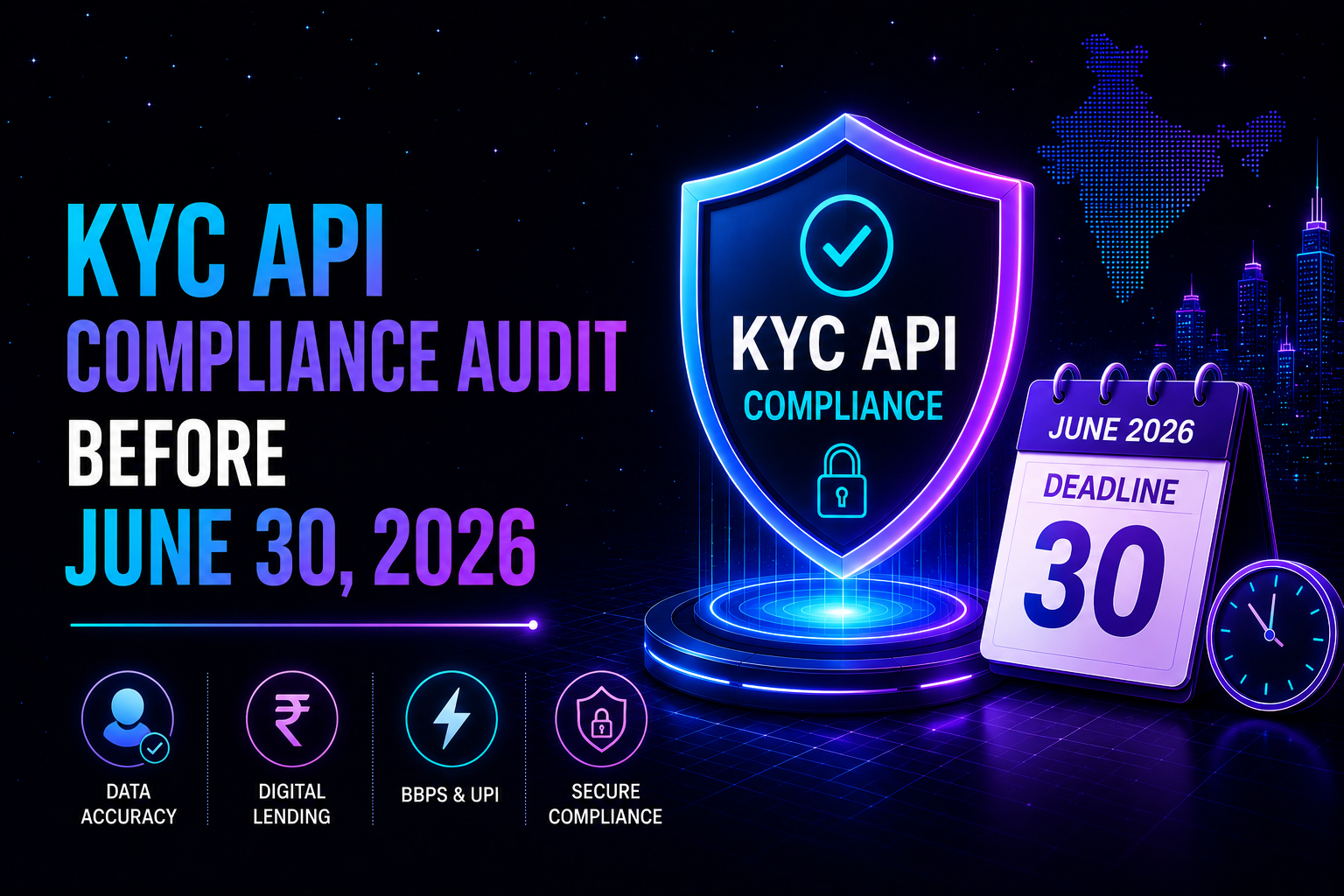
As we approach the final week of June 2026, the Indian fintech landscape is bracing for a series of major regulatory shifts. For platform owners, developers, and CTOs, the conversation is no longer just about user experience; it is about KYC API Compliance. With the Reserve Bank of India (RBI) and the National Payments Corporation of India (NPCI) tightening the screws on digital identity and lending frameworks, your API architecture must be ready to adapt within days, not months.
The June 30 deadline is not just a date on the calendar; it is a hard cutoff for operational compliance across multiple financial sectors. If your platform facilitates digital lending or periodic KYC updates, understanding the nuances of KYC API Compliance is the difference between seamless scaling and a total service shutdown. In this guide, we dive deep into the technical requirements you need to implement in the next 30 minutes to ensure your blog and business remain at the forefront of the industry.
The “Last-Entity” Rule: A New Era of Data Accountability
One of the most significant changes hitting the CKYC (Centralized KYC) Registry is the shift in legal accountability. According to recent amendments, the primary legal burden for verifying customer data now shifts to the entity that last updated the record. For developers, this means your KYC API Compliance strategy must now include rigorous validation logic for every write-request sent to the registry.
When your API pushes a user update, your system is essentially “signing off” on the accuracy of that data for the entire ecosystem. This makes KYC API Compliance more than a security feature; it is now a core legal requirement. You must ensure your API documentation clearly outlines how your platform handles data provenance and verification timestamps to protect your business from future liability under the new RBI norms.
The June 30 Digital Lending Deadline: Are Your APIs Ready?
Digital lending platforms face a critical deadline of June 30, 2026, to demonstrate full operational compliance with the RBI’s updated digital lending framework. This framework requires a complete overhaul of how lending APIs interact with third-party service providers. Achieving KYC API Compliance in this context means ensuring that every loan disbursement is preceded by a verified, real-time identity check that leaves a clear audit trail.
Many legacy systems still rely on cached KYC data, which is a major red flag under the new guidelines. To maintain KYC API Compliance, your lending stack must move toward “stateless” verification, where the identity of the borrower is re-validated through a secure API call at the point of every transaction. This level of KYC API Compliance ensures that your platform remains compliant even as the RBI introduces stricter “dark pattern” bans and forced bundling protections.
According to the official RBI Master Direction (Amendment) 2025, Regulated Entities must ensure KYC API Compliance by the June 30 cutoff for all individual customers categorized as low risk.
NPCI’s Drunix: The Future of API-Driven Trust
While immediate deadlines loom, the NPCI has unveiled “Drunix,” an open-source blockchain platform based on Hyperledger Fabric. This platform is designed to facilitate enterprise tokenization and scalable digital asset management. For forward-thinking businesses, KYC API Compliance will soon involve integrating with Drunix to provide tokenized identity solutions that are immutable and universally verifiable.
Integrating with Drunix requires a high level of technical maturity. Your KYC API Compliance roadmap should include a transition plan to move away from centralized databases toward these decentralized ledgers. By doing so, you not only satisfy current RBI mandates but also position your platform to handle the next generation of “Agentic” workflows where AI agents autonomously manage KYC for users.
Optimizing BBPS and UPI for High-Speed Compliance
Beyond identity, the NPCI has introduced new settlement cycles (Cycle 9 and 10) for the Bharat Bill Payment System (BBPS) to mitigate risk. While this may seem like a backend change, it has a direct impact on your KYC API Compliance. Faster settlement cycles require faster identity verification to prevent fraudulent reversals in high-frequency payment environments.
Similarly, the new rules for Credit Lines on UPI (CLOU) demand that KYC API Compliance be integrated directly into the payment flow. The RBI has clarified that credit lines linked to UPI must adhere to the same regulatory standards as traditional loans to eliminate regulatory arbitrage. This means your UPI API must be capable of performing a “mini-KYC” or a full re-validation without introducing latency that ruins the user experience.
A Checklist for Achieving 100% KYC API Compliance
To ensure you hit your targets by June 30, follow this technical checklist for your KYC API Compliance audit:
- Audit Low-Risk Updates: Ensure your API triggers automatic notifications for the June 30 periodic update deadline for low-risk customers.
- Implement Webhooks for CKYC: Use real-time webhooks to monitor when other entities update a record you have previously verified to maintain KYC API Compliance data fresh.
- Review CLOU Integration: If you use UPI credit lines, ensure your KYC API Compliance logic is consistent across both your web and mobile SDKs.
- Update Documentation: Reflect the new “Last-Entity” accountability rules in your developer portal to ensure third-party integrators understand their role in KYC API Compliance.
Conclusion: The Path Forward for API Galaxy
The shift toward “Agentic” security and machine-to-machine verification is inevitable. However, the first step is mastering the basics of KYC API Compliance as defined by the RBI and NPCI for June 2026. By focusing on KYC API Compliance today, you are not just checking a box for a regulator; you are building a foundation of trust that will allow your platform to scale into the blockchain-driven future of Indian fintech.
Don’t wait until June 30 to discover a gap in your architecture. Perform your KYC API Compliance audit tonight and ensure your platform remains the gold standard for secure, efficient, and compliant API services in India.
As the industry moves toward a trust-first economy, your KYC API Compliance strategy must evolve. Explore our vision for the future of identity in Verification APIs: The Backbone of Secure Digital Identity in a Trust-First Economy.