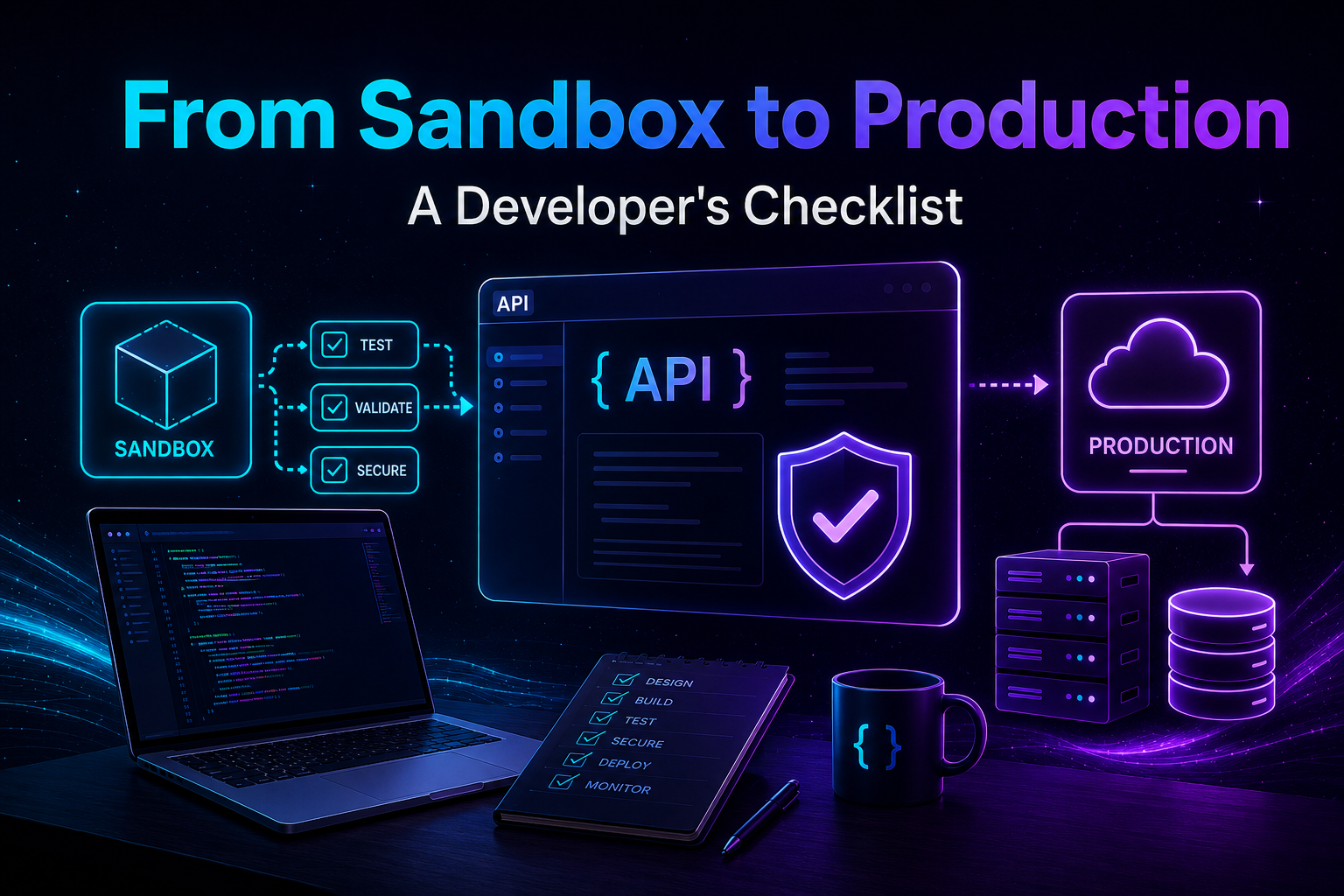
Sandbox to Production is not just a technical step. It is the moment where test data becomes real customer data, sample responses become live transactions, and small errors can start affecting actual users.
For developers, product managers, and founders, this stage often feels exciting. The integration finally works. The dashboard looks stable. The API response is coming correctly.
But live environments are different.
A missed webhook, weak error handling, incorrect credentials, rate-limit confusion, or poor monitoring can quietly damage onboarding, payments, verification, refunds, and customer trust. That is why API Galaxy believes production readiness should be treated as a serious operational checklist, not a last-minute deployment task.
In India’s digital ecosystem, this matters even more. According to RBI’s 2025-26 Annual Report, UPI accounted for nearly 86% of total retail payment transactions during the year, while UPI transaction volume grew by 30% and value by 20.6%. RBI Annual Report 2025-26
When digital payments, KYC, recharge, bill payments, and onboarding depend on APIs, reliability becomes part of the customer experience.
What Does Sandbox to Production Really Mean?
Sandbox to Production means moving an API integration from a test environment to a live environment where real users, real data, and real transactions are involved.
A sandbox is designed for learning and testing. It helps developers check endpoints, payload formats, response structures, authentication methods, and basic workflows without business risk.
Production is different.
Production means live API keys, actual customer verification, real money movement, genuine compliance requirements, and direct business impact.
For example, if a company is testing PAN verification, Aadhaar verification, GST verification, Recharge API, Bill Payment API, Travel API, or payment infrastructure, the sandbox may confirm that the flow works. But the production environment proves whether the business is actually ready to handle volume, errors, retries, support tickets, and customer expectations.
That is why API Galaxy focuses on developer-friendly APIs, secure digital transaction systems, real-time dashboards, and scalable API infrastructure that help teams move carefully from testing to live usage.
Why a Sandbox to Production Checklist Matters
A Sandbox to Production checklist matters because many API issues do not appear during simple testing.
In a test environment, traffic is controlled. The developer usually knows what input is being sent. There is no real customer waiting, no refund dispute, no compliance risk, and no frustrated support team asking why a transaction failed.
In production, everything becomes less predictable.
Users may enter incorrect data. Networks may timeout. Third-party systems may delay responses. Webhooks may fail. Authentication tokens may expire. Rate limits may be reached during peak hours.
The RBI Payments Vision 2025 also highlights that secure, reliable, accessible, affordable, and efficient payment systems are core goals for India’s digital payments ecosystem. RBI Payments Vision 2025
For businesses, this means API reliability is not a backend-only concern anymore. It directly affects trust.
A startup using API Galaxy for KYC Verification API, PAN Verification, GST Verification, Recharge API, or Bill Payment API needs more than a working endpoint. It needs clarity, logs, monitoring, compliance readiness, and support when something breaks.
Sandbox to Production Checklist for Developers
Before going live, every team should review the basics carefully. This checklist is especially important for fintech apps, SaaS platforms, onboarding systems, travel platforms, recharge portals, and verification workflows.
1. Confirm API Credentials and Environment URLs
The first step in Sandbox to Production is making sure your production credentials are correct.
Check:
- Production API key
- Secret key or token
- Correct base URL
- IP whitelisting if required
- Environment-specific configuration
- Callback URLs
- Webhook endpoints
One common mistake is accidentally using sandbox credentials in production code or production credentials in a staging setup. This can create confusing failures that look like API downtime but are actually configuration errors.
API Galaxy helps teams avoid this confusion by keeping API documentation and environment details clear for developers.
2. Validate Authentication and Access Control
Authentication should never be treated as a copy-paste task.
Before Sandbox to Production, confirm how authentication works in the live environment. Check whether the API uses tokens, headers, signatures, encryption, access keys, or IP restrictions.
Also verify who inside your team has access to production credentials. Production keys should not be casually shared across WhatsApp, email, or open documents.
This is especially important for businesses searching for the Best API Provider in India because security should be part of the provider evaluation, not an afterthought.
3. Test Error Handling Properly
Many teams test only the happy path.
A user enters valid details. The API returns success. The integration feels complete.
But real systems need to handle:
- Invalid PAN numbers
- Incorrect GSTIN details
- Expired sessions
- Duplicate requests
- Timeout responses
- Server errors
- Rate-limit responses
- Pending transaction status
- Failed webhook delivery
API Galaxy encourages teams to design for both success and failure states because production users do not care whether the issue came from frontend, backend, API, or network. They only see whether the experience worked.
4. Review Rate Limits and Traffic Spikes
A smooth test with 20 requests does not prove that your system is ready for 20,000 requests.
Before Sandbox to Production, understand the API rate limits, expected traffic, retry logic, and peak-hour behavior.
This matters during:
- Sale campaigns
- Festival recharge spikes
- Salary-day payments
- Loan onboarding campaigns
- New app launches
- High-volume verification drives
For companies comparing the Best Verification API Provider in India, rate-limit clarity and scalable infrastructure should be key decision points.
5. Check Webhooks and Callback Reliability
Webhooks are often ignored until they fail.
If your system depends on status updates, transaction confirmation, verification result delivery, or payment response callbacks, webhook testing is critical.
Before launch, check:
- Is the webhook URL live?
- Does it use HTTPS?
- Can it handle duplicate callbacks?
- Does it verify signatures?
- Are failed callbacks retried?
- Are logs stored clearly?
- Does your backend update status correctly?
A strong Sandbox to Production process should include webhook failure scenarios, not just successful callback testing.
6. Prepare Monitoring, Logs, and Alerts
In production, visibility matters.
If something fails, your team should know quickly. Waiting for customers to complain is not monitoring.
Set up:
- API request logs
- Response logs
- Error tracking
- Latency monitoring
- Transaction status tracking
- Webhook logs
- Dashboard alerts
- Support escalation flow
API Galaxy’s real-time dashboards help businesses track API usage and transaction activity more clearly, which is useful for developers, founders, support teams, and operations managers.
7. Confirm Compliance and Data Handling
Production APIs often handle sensitive user data.
This may include PAN details, Aadhaar-based verification flows, GST information, bank verification data, mobile-linked data, payment details, or business identity records.
Before Sandbox to Production, review:
- What data is collected
- Where data is stored
- Who can access it
- How long logs are retained
- Whether masking is required
- Whether consent is captured
- Whether your privacy policy reflects actual workflows
This is where choosing among the Top Identity Verification API Providers in India becomes more than a pricing decision. The right partner should support secure, compliant, and dependable verification infrastructure.
Common Sandbox to Production Mistakes Teams Make
The most common Sandbox to Production mistake is rushing.
A founder wants to launch quickly. A developer wants to close the task. A product manager wants the feature live before the campaign starts.
That pressure is real. But rushed production movement often creates hidden problems.
Common mistakes include:
- Testing only successful responses
- Ignoring failed transaction flows
- Not checking live credentials
- Missing webhook retries
- No internal alert system
- Weak documentation
- No rollback plan
- No support ownership
- Not testing with real-world input formats
- Assuming sandbox behavior will exactly match production behavior
API Galaxy often fits into this stage as a technology partner because businesses need more than API access. They need stability, documentation, dashboards, and reliable backend support when real users are involved.
Why API Infrastructure Matters More Than Flashy Apps
A clean app design can attract users.
But infrastructure keeps them.
If PAN verification fails during onboarding, users may leave. If a recharge transaction remains pending without clear status, customers may lose trust. If a bill payment confirmation is delayed, support tickets increase. If a travel booking API fails during checkout, revenue may disappear instantly.
That is why API infrastructure matters.
India’s digital transaction ecosystem has moved beyond “online convenience.” People now expect instant confirmation, accurate verification, secure payments, and transparent status updates.
API Galaxy supports this shift through scalable API infrastructure for verification APIs, KYC systems, Recharge API, Bill Payment API, Travel API, UPI and payment infrastructure, fraud detection systems, and secure digital transaction workflows.
For developers, this means fewer unknowns.
For founders, it means more confidence.
For customers, it means fewer broken experiences.
How API Galaxy Helps Teams Move Confidently
Sandbox to Production becomes easier when the API provider understands real business pressure.
API Galaxy is built for teams that need practical, reliable, developer-friendly API solutions across verification, payments, recharge, bill payments, travel, and digital transaction systems.
Its role is not just to provide endpoints. The value lies in helping businesses build dependable workflows where verification, payment status, transaction logs, dashboard visibility, and support systems work together.
For a startup, that can mean faster onboarding.
For an enterprise, it can mean better operational control.
For a developer, it can mean cleaner integration and fewer unclear errors.
And for a product team, it can mean launching with more confidence instead of simply hoping the production environment behaves well.
Final Thoughts
In the end, Sandbox to Production is not just a deployment step. It is a trust step.
It asks a simple question:
Is your system ready for real people?
Not test users. Not sample data. Not perfect inputs.
Real customers, real transactions, real verification attempts, real delays, real mistakes, and real business consequences.
For modern Indian businesses, API readiness is becoming part of brand trust. Whether you are building onboarding, payments, recharge, bill payments, travel booking, fraud checks, or identity verification, your backend infrastructure quietly shapes the customer experience.
API Galaxy helps teams treat that responsibility seriously with secure, scalable, and practical API systems designed for real-world usage.
Recommended Read:
Before moving live, also check our guide on API Sandbox Testing: 5 Powerful Checks Before Go-Live to make sure your API setup is properly tested and production-ready.